Sweet truth
Loading article...
-
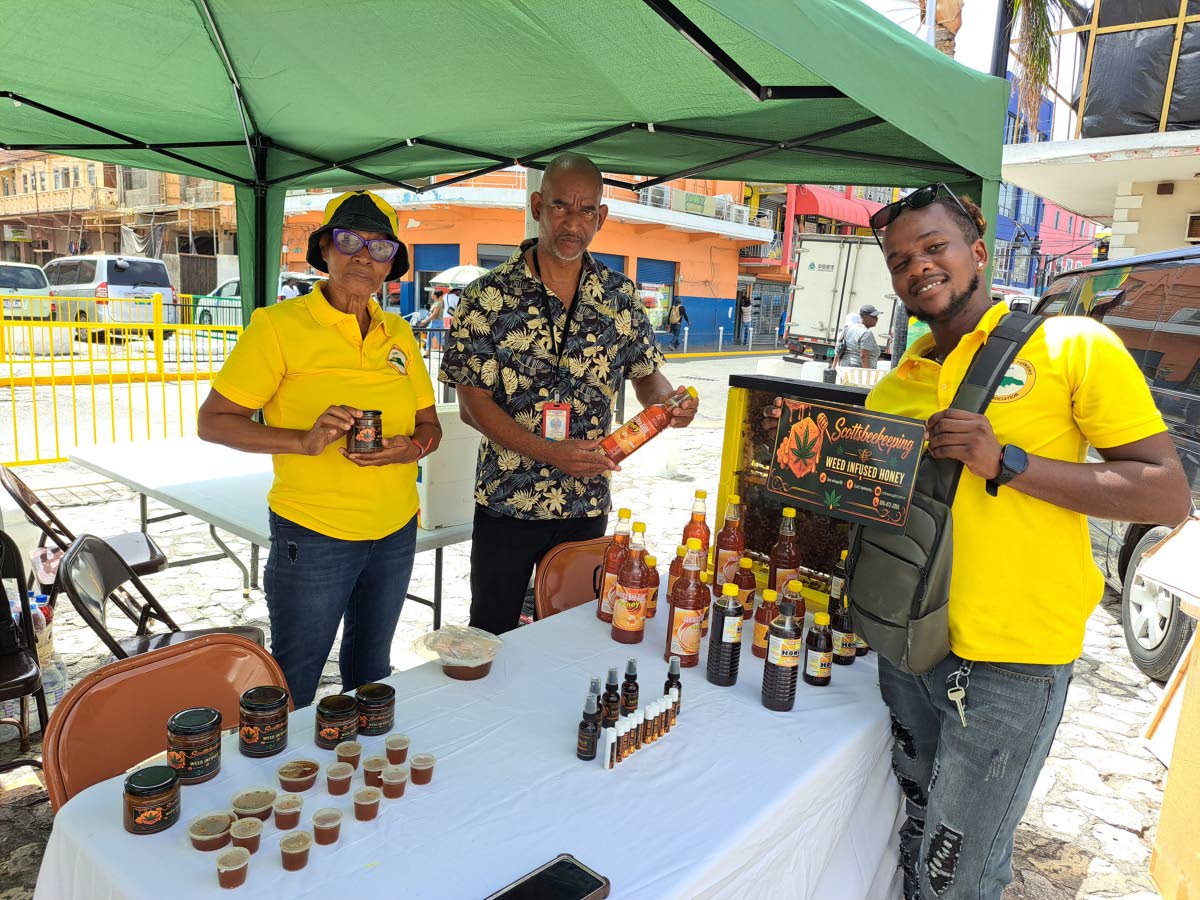 From left: Maurva Hines-Stone, operator of the Stone Ridge honey brand in Garlands, St James; Hugh Smith, the chief plant protection officer in the Ministry of Agriculture, Fisheries, and Mining’s Apiculture Unit; and Romario Scott, operator of the Scottsbeekeeping honey brand in Cornwall Courts, St James, showcase honey products during the St James Bee Farmers Association’s fourth annual Healthy Lifestyle Day at Sam Sharpe Square in Montego Bay, St James on Thursday.
-
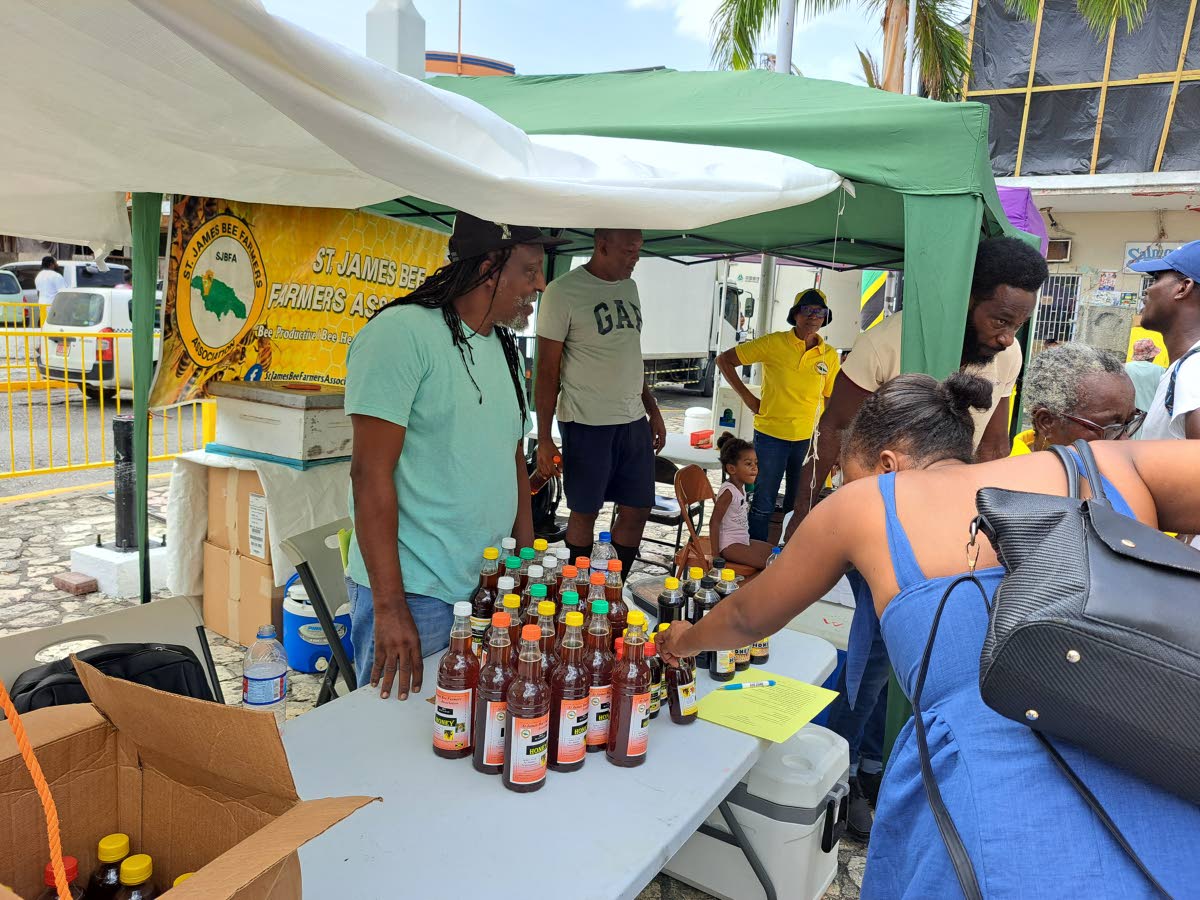 Dennis McKay (left), the chairman of the St James Bee Farmers Association, caters to patrons during the association’s fourth annual Healthy Lifestyle Day.
WESTERN BUREAU:
Beekeepers and other stakeholders in Jamaica’s apiculture industry are poised to receive educational sessions on how to identify genuine honey and distinguish it from fake or synthesised honey, as well as how to help bee farmers get their honey-based products regularised for the local and international markets.
Hugh Smith, the chief plant protection officer in the Ministry of Agriculture, Fisheries, and Mining’s Apiculture Unit, made the disclosure on Thursday in an interview with The Gleaner during the St James Bee Farmers Association’s fourth annual Healthy Lifestyle Day at Sam Sharpe Square in Montego Bay.
“We have collected 63 honey samples which will be analysed overseas, and the collected samples will be logged in a database. If you find a honey product, and it is named Jamaican honey, you can check in the database to see if it is Jamaican honey, so there is a reference point for the region that is now being built in terms of making sure that authentic Jamaican honey remains authentic and is not abused by other persons,” said Smith.
“We will also be enlightening the industry as to what this authentication programme is all about, and so we are expecting to have a session in another week or two on honey authentication. The beekeeping public, the traders, and all persons in the value chain will know exactly what is authentication of honey and how we can protect our local Jamaican honey from imposters and from persons using Jamaica’s name to say it is Jamaican when it is not,” Smith explained.
According to Smith, while the issue of fake honey is not widespread in Jamaica, authentication is necessary to prevent individuals from manipulating the honey trade with non-genuine honey solely for profit, especially as the price of real honey increases.
“The European Union (EU) requires you to be able to say that your product is genuine, and internationally, the whole issue of fake honey is there, where they are synthesising or making a product and then packaging it and selling it as honey. The other issue is adulteration, where honey is being preyed upon by adding sweeteners and other things to the honey, but in real terms, it is not honey,” said Smith.
STUDY FINDINGS
An investigation conducted by the European Commission, the EU’s main executive body, between 2021 and 2022 found that approximately 46 per cent of honey imported into the EU did not comply with the provisions of the EU’s directives for identifying genuine honey. It also found that 57 per cent of EU operators exported honey consignments that were suspected of being adulterated with extraneous sugars.
Meanwhile, St James Bee Farmers Association chairman Dennis McKay said Thursday’s Healthy Lifestyle Day, which was held in collaboration with the St James Municipal Corporation and the St James Health Department, was intended to showcase beekeeping and its resulting honey-related products, including edible honey, hair oils, shampoo, ointments, and soaps, as potential income generators at the personal and national levels.
“We are going in an era where artificial intelligence is taking over, and we want to introduce more people into beekeeping, and thereby introduce them to another opportunity to live, survive, and be self-employed. We want to at least let the public be aware that it is time we start to advance into other avenues of life where we can be hands-on and do things,” said McKay.
“Beekeeping is one of the ways to build the economy so that we do not necessarily only have to rely on tourism to exist. Jamaica so far has not produced enough honey to export, but if we can get more people into it, then we can say this is another avenue of building the economy of Jamaica.”
Jamaica’s apiculture sector suffered an estimated $74.5 million in damage when Hurricane Melissa drastically reduced the local bee population during its destructive passage last October. Since then, the Ministry of Agriculture’s Apiculture Unit has been encouraging Jamaicans to help sustain the bee population and boost food security efforts through backyard gardening and planting more flowers.
christopher.thomas@gleanerjm.com