Police deny hijacking event permit process
Loading article...
-
 Scean Barnswell, minority leader of the Clarendon Municipal Corporation.
-
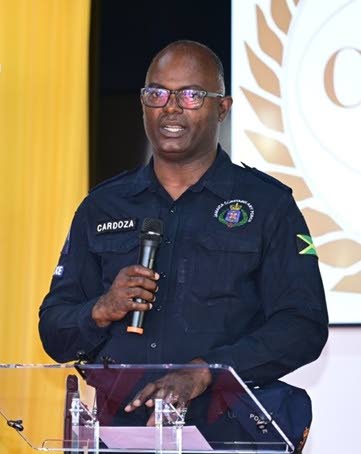 Superintendent Anton-Gur Cardoza, acting head of the Clarendon Police Division.
The Opposition has accused the Jamaica Constabulary Force (JCF) of usurping the role of municipal corporations (MCs) by effectively deciding which entertainment events receive permits, depriving cash-strapped councils of a major revenue stream. But the police have rejected the claim.
At a press conference yesterday, Councillor Scean Barnswell, minority leader of the Clarendon Municipal Corporation, accused the police of increasingly blocking approvals for places of amusement, despite municipal corporations having the legal authority to issue the permits.
“We have been having issues with places of amusement because the police are of the view that they have the last say in approval of permits,” Barnswell charged. “The last time I checked, it is the municipal corporation that has that authority to give an approval. All that is needed from the JCF are comments on these applications, and then we give the approval or not.”
Barnswell argued that the shift has had a direct financial impact on MCs, particularly Clarendon, where entertainment permits generate significant own-source revenue.
“I highlight that particular revenue stream because in Clarendon, it is one of our main revenue streams. Since the police have now been regulating approvals and closures of entertainment zones, it has impacted the municipal corporation,” he said.
Responding to the allegations, Superintendent Anton-Gur Cardouza, acting commander of the Clarendon Police Division, said the police and municipal corporation operate under a memorandum of understanding and jointly assess applications.
“What we consider at the end of the day is safety, and we have a partnership with the municipal corporation. We work together in deciding which events will, at the end of the day, get a permit,” Cardouza told The Gleaner.
Place of amusement licence
While municipal corporations issue licences for places of amusement, the police alone grant permits under the Noise Abatement Act, he noted.
“We do have a certain amount of autonomy in that we grant a noise abatement permit, and this is something nobody else can grant. We also recognise that part of issuing a permit under the Noise Abatement Act is that there must also be a place of amusement licence.”
Cardouza said all applications are first routed through the municipal corporation, then reviewed by the police, who conduct security assessments before making a decision.
“At the end of the day, it is solely for safety,” he said.
He said permits will not be approved if intelligence suggests events are being organised by criminals or scammers, are linked to money laundering, or are likely to expose patrons to violence. Applications may also be denied where venues cannot provide adequate parking or are likely to create excessive noise nuisance.
“Police have been doing their intelligence work, and we are not going to wait and allow people to be killed,” Cardouza said, adding that some venues and communities have effectively been blacklisted because of persistent security concerns. In many cases, he said, promoters have relocated events and subsequently received approval.
While he could not provide figures on applications received this year, Cardouza said dozens cross his desk each week and that a large percentage are approved.
The disagreement surfaced as Opposition spokesperson on local government Natalie Neita Garvey challenged recent statements by Local Government Minister Desmond McKenzie that MCs receive between $600 million and $700 million each month for road maintenance.
Addressing a handover ceremony for grants under the Clean-Up and Restoration Initiative in St James recently, McKenzie said the monthly allocation is distributed among local authorities based on the number of roads in each parish.
Neita Garvey, however, described the minister’s figures as misleading.
She said the average monthly subvention shared among all 14 MCs is approximately $473 million, with the Kingston and St Andrew Municipal Corporation receiving the largest allocation of about $85 million monthly and Hanover the smallest, at roughly $13 million.
“The figures presented to the Jamaican public have been inflated, combining funding streams that are either restricted or simply unavailable for routine road maintenance. This is not merely an accounting issue; this is political propaganda,” she charged.
According to Neita Garvey, the allocations available to individual MCs are inadequate to address deteriorating road networks and other critical infrastructure.
She argued that at current funding levels, it would take a councillor about four years to finance the rehabilitation of just one kilometre of roadway with side drains.
Barnswell said the financial strain extends beyond road maintenance.
He noted that MCs must also fund infirmaries, drop-in centres, utilities, staff salaries and the care of social cases, including food, medication and building repairs, largely from their own-source revenues.
Hurricane Beryl recovery funds
He also questioned why approximately $158.8 million in unspent Hurricane Beryl recovery funds remains idle while residents in Clarendon continue to struggle two years after the disaster.
“Clarendon was one of the parishes greatly impacted. The unspent sum is $158.8 million sitting there idling while people in Clarendon are still suffering from the experience of Beryl,” he fumed.
MCs generate revenue through a range of fees, including markets, transportation centres, parks, cemeteries, home burials, trade licences, and permits for barbers, hairdressers, butchers and places of amusement. Barnswell described many of those fees as modest.
The Opposition is calling for greater transparency in the allocation of local government funding, a fairer financing model and increased investment in MCs, arguing that councillors from both major political parties are being unfairly blamed for deteriorating roads despite operating with inadequate resources.
corey.robinson@gleanerjm.com