Davalle Grant | Politics of information control should be rejected
Loading article...
-
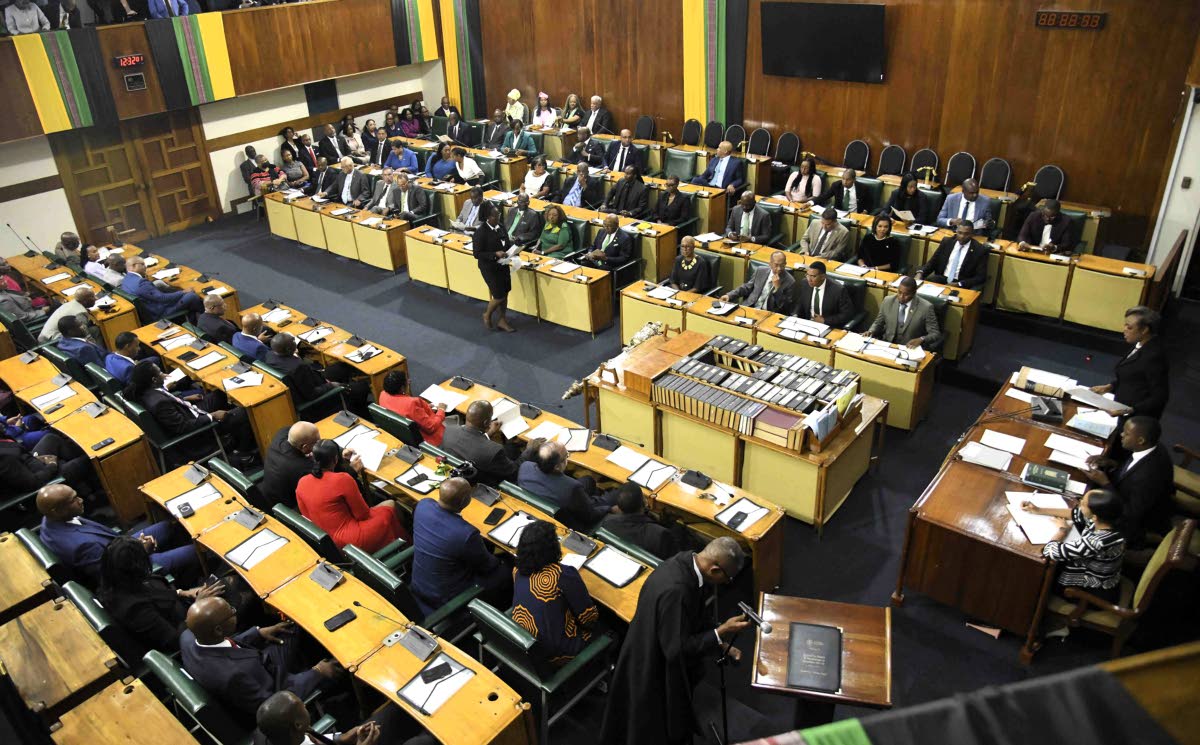 Members of Parliament before at the swearing-in ceremony for members of the upper and lower houses of Parliament held on September 18, 2025 in Gordon House. Photo - File
-
Members of Parliament before at the swearing-in ceremony for members of the upper and lower houses of Parliament held on September 18, 2025 in Gordon House. Photo - File
-
 Davalle Grant. Photo - Contributed
At its annual conference on November 15, the Jamaica Labour Party (JLP) passed a resolution calling for the Government to consider establishing a dedicated Ministry of Information and an anti-disinformation unit.
Beneath the seemingly innocent language lies a serious question that every Jamaican should be asking: Who gets to decide what is true, and when a citizen has crossed the line from criticism into disinformation?
There is no denying that misinformation is a growing problem. Social media, artificial intelligence and digital technology have made it easier than ever to manufacture false narratives, manipulate images and spread misleading information. However, the solution cannot be to place the Government in a position where it becomes both a participant in political debate and the referee determining what constitutes the truth. A government cannot be allowed to mark its own examination paper.
The Holness administration has repeatedly found itself at odds with critics, commentators and members of the public who question its decisions and performance. Rather than establishing yet another institution to counter negative narratives, the Government should be asking why so many Jamaicans are questioning its credibility. A government confident in its record should have no difficulty defending that record with evidence, transparency and facts.
CONSIDERABLE RESOURCES
The Government already possesses considerable resources for communicating with the Jamaican people. The Jamaica Information Service (JIS) exists to disseminate information about government policies, programmes and activities. Ministries and other public agencies also maintain communication and public relations capabilities. Why, then, should taxpayers finance another layer of bureaucracy to perform functions that existing institutions are already equipped to undertake?
What would this new ministry cost? How many additional positions would be created? What powers would the proposed anti-disinformation unit possess? Who would oversee its operations, and what mechanisms would protect citizens against political abuse? Of particular concern is the possibility that political disagreement could increasingly be characterised as misinformation.
There is a fundamental difference between a deliberate falsehood and a legitimate difference of opinion. A citizen questioning the distribution of government resources is not necessarily spreading misinformation. A journalist challenging official figures is not engaging in disinformation. An Opposition representative exposing weaknesses in public policy is exercising a legitimate democratic responsibility. Yet without clearly defined limits and independent oversight, an anti-disinformation unit operating within government could become an instrument for discouraging precisely these forms of scrutiny.
This concern is not without context. Recently, a government senator publicly advocated the return of criminal sanctions for defamation, a position from which the Information Minister subsequently distanced the administration. Jamaica abolished criminal defamation in 2013, recognising the importance of protecting freedom of expression. We should be extremely cautious about any initiative that risks taking us backwards.
Across Jamaica, families continue to struggle with the cost of living. Communities are demanding improved roads, functioning streetlights, reliable water supplies, better healthcare and stronger educational opportunities. The country is also confronting the enormous task of rebuilding communities affected by Hurricane Melissa. Against this background, the Government must explain why creating an entirely new ministry should be a national priority. Every dollar of public expenditure must be justified by demonstrable public benefit. Taxpayers should not finance an institution whose purpose, costs and safeguards remain unclear.
ENTITLED TO PROMOTE
The interests of the governing party are not automatically the interests of the Jamaican State. The JLP is entitled to promote its achievements, challenge its opponents and defend its political reputation. That is the legitimate work of its political organisation, supporters and communication machinery, but the resources of the State belong to the Jamaican people, including those who did not vote for the JLP. They must never become instruments for advancing the political interests of whichever party occupies Jamaica House.
If the objective is genuinely to strengthen the public’s ability to identify false information, there are more constructive approaches. Invest in media literacy and digital education. Strengthen access to government information. Publish accurate and timely data on public expenditure and programme delivery. Support independent journalism and fact-checking. Improve the ability of existing public institutions to communicate clearly and respond promptly to public concerns. The Broadcasting Commission has already developed a framework addressing digital, media and information literacy. Building on such initiatives would be far more reassuring than creating a new government-controlled mechanism whose authority remains undefined.
Public trust cannot be legislated into existence, nor can it be manufactured through a communication strategy. Trust is earned through consistent honesty, accountability, competence and performance. Jamaica has a proud democratic tradition, built through generations of struggle to secure political freedoms and the right of citizens to challenge those who govern them.
Any proposal that could affect how Jamaicans express themselves, criticise public officials or participate in national debate deserves the highest scrutiny. The JLP should therefore abandon the proposal for a new Ministry of Information and explain what it intends by an anti-disinformation unit, including its proposed powers, oversight and safeguards. The Government has every right to correct misinformation. It has no right to appoint itself the final authority on truth. The country does not need a Ministry of Truth. It needs a government willing to confront uncomfortable truths, answer difficult questions and accept that criticism is one of democracy’s greatest safeguards.
Davalle Grant is the general secretary of PNP Patriots. Send feedback to columns@gleanerjm.com