Elizabeth Morgan | Jamaica’s UNGA Cuba vote: is US/Cuba dialogue realistic?
Loading article...
-
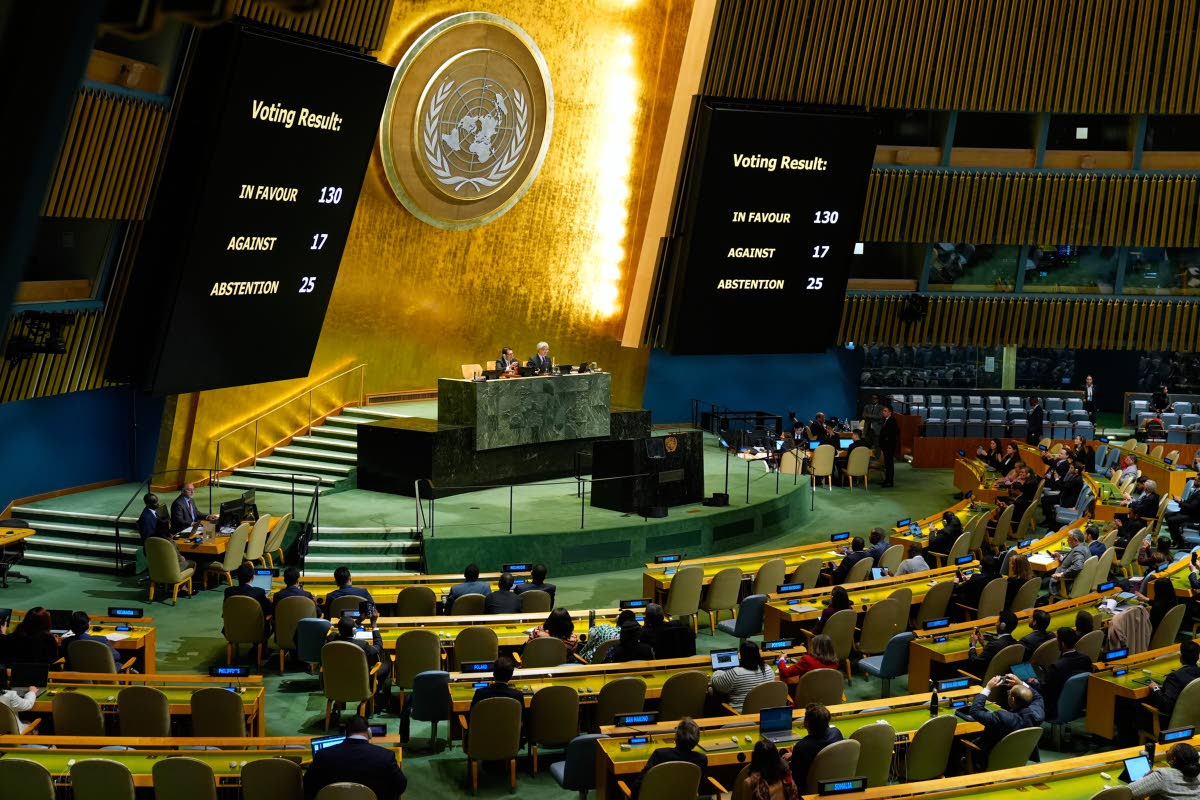 The results of a vote on ending the United States’ blockade of Cuba are displayed at United Nations headquarters. Photo - AP
-
The results of a vote on ending the United States’ blockade of Cuba are displayed at United Nations headquarters. Photo - AP
-
As noted in other columns, there are important events taking place now, the Commonwealth Heads of Government Meeting (CHOGM) in Antigua and Barbuda, November 1-4, and the US midterm elections, November 3. This column will not focus on those, as the outcome of the CHOGM will not be known until about Wednesday. The outcome of the midterm elections will not be fully known until late Tuesday night or early Wednesday morning. This column will not address the polls and speculate on outcomes, as US polls have been wrong in past elections.
This column, like others, is concerned about Jamaica’s abstention in the vote on the US trade embargo against Cuba in the UN General Assembly (UNGA) on October 28 and will focus on that. The US/Cuba situation has been addressed in this column on January 11 in ‘Democracy Hypocrisy’”, and, on June 2 in ‘Another Caribbean Tragedy in the Making?’
The UNGA Cuba vote
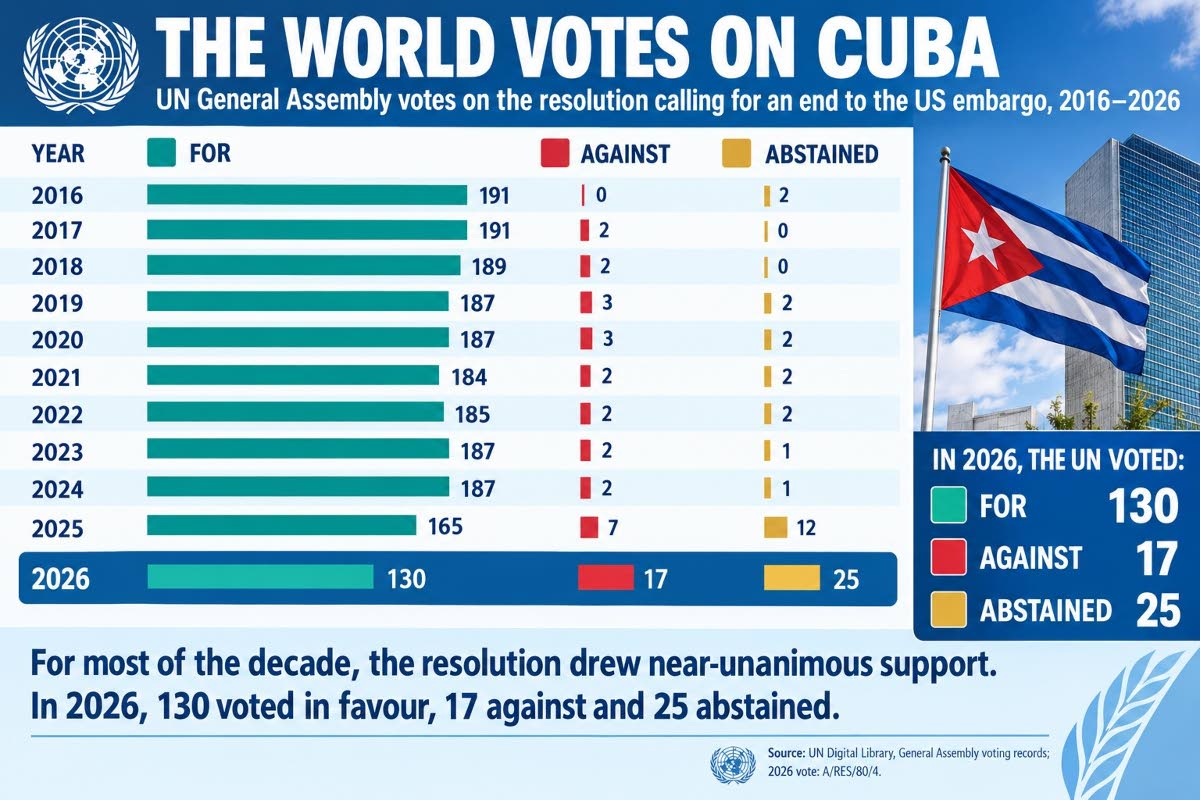
This was the 34th year in which this resolution calling for an end to the US trade and economic embargo against Cuba was presented and addressed in the UNGA. In 2024, the vote was 187 in favour, two against (USA and Israel) and one abstention (Moldova). In 2025, the vote was 165 in favour, seven against, and 12 abstentions. In 2026, it was 130 in favour, 17 against, and 25 abstentions. Until 2026, Jamaica supported this resolution. This year, Jamaica’s vote changed to abstention.
It is clear that with the return of President Trump in 2025 and with the US’ revised approach to foreign policy in the W,estern Hemisphere with the Trump Corollary to the Monroe Doctrine, the US has taken a more hardline approach to Cuba. This revised foreign policy approach was outlined in the new US National Security Strategy (refer columns on December 10, 2025 on “the US National Security Strategy: modernising the Monroe Doctrine” and on January 7 on “Are countries in the Western Hemisphere to become more subjugated US satellites?”).
It is reported in the international media that, for this year’s vote, the US actively lobbied UN member states to change their vote on this resolution and to support the US by either voting against or abstaining. You can imagine that this lobbying was very intense in Latin America and the Caribbean.
From a State Department’s press release, the US Deputy Secretary of State, Christopher Landau, hosted the US-Caribbean Dialogue in Washington DC on October 15 which was attended by high-level representatives from CARICOM countries, including Jamaica.
Cuba’s unique situation
Note that the sanctions against Cuba are imposed solely by the US. They are unilateral and applied extraterritorially. This includes the 1996 Helms/Burton Act restricting other countries’ investments with Cuba. This makes Cuba’s situation unique within the international system. The US continues to do normal business with other countries, China, Vietnam and Laos, which are one-party communist states.
The US did not have diplomatic relations with Cuba from 1961 to 2015. Diplomatic relations were restored in 2015 under Democratic President Barack Obama with support from Pope Francis and the Holy See. An effort was made under that administration to improve the relationship. The relations became further strained under the Republican Trump Administration when restrictions were reimposed. Democratic President Joe Biden, on his election, sought again to improve relations. A US move towards some gradual lifting of the embargo may have encouraged the Cuban regime to move towards reform. This did not happen.
With the return of President Trump in 2025 and the appointment of Marco Rubio, of Cuban descent, from Florida, as the secretary of state, restrictions on Cuba were further tightened. More unilateral sanctions were imposed on the Cuban regime and on other countries trading with Cuba, especially those trading fuel. The US severed Cuba’s link with Venezuela, which was a primary source of fuel.
Impact of the Cuban diaspora in Florida
It is very important to understand the history of the Cuba/US relationship. Cuba was a pseudo colony of the US after the Spanish American War (1898) and being given independence in 1902. The US, by legislation, retained the right to intervene in Cuba’s affairs. The Cuban president was subordinate to the US ambassador. During and after the 1959 Castro revolution, a large number of Cubans opposed to the regime migrated to Florida. In the 1960s, the Castro regime nationalised US-owned and other businesses. The Cubans in South Florida have not forgotten nor forgiven these actions by the Castro regime. Their aim is to see its demise. Attempts, working with the US government, to overthrow the regime were unsuccessful.
The nearly two million Cuban-Americans in Florida are a quite powerful voting bloc. They are mainly Republicans and were able to elect representatives at the state and federal levels. Marco Rubio was a senator from Florida. This diaspora influences US/Cuba policy and supports regime change.
Dialogue between the USA/Cuba
Secretary of State and National Security Advisor Marco Rubio’s ambition is to effect regime change in Cuba. Thus, the screws are being tightened on the Cuban regime and, indeed, on the Cuban people, although it is said that that is not the intent. It is suspected that, had the US not become involved in a war with Iran, the objective would be to use the US military against Cuba.
It is reported that Secretary Rubio was in dialogue with a member of the Castro family. US CIA Director John Ratcliffe, went to Cuba in May, reportedly with an unsuccessful ultimatum/offer. The situation between the US and Cuba now seems so toxic, with more sanctions and threats, that it is not possible to see high-level dialogue between them. There is also no indication that the US administration is interested in dialogue.
Jamaica’s vote
We would all like to see the US and Cuba agree on dialogue to improve relations and for Cuba to move towards a more democratic and market-based economy. It is feared, however, that this is not the intent of Secretary Rubio and the Trump Administration. It is, perhaps, a change in Congress that might see some moderation in the US position. Hopefully, there is some diplomatic mission behind the scenes.
At the UNGA, this column would have preferred to see Jamaica maintaining its yes vote, while calling for dialogue in its explanation.
Elizabeth Morgan is a specialist in international trade policy and international politics. Send feedback to columns@gleanerjm.com.