Janiel McEwan | Earning the chair: Dr Brian Langrin and the long apprenticeship of a Jamaican economist
Loading article...
-
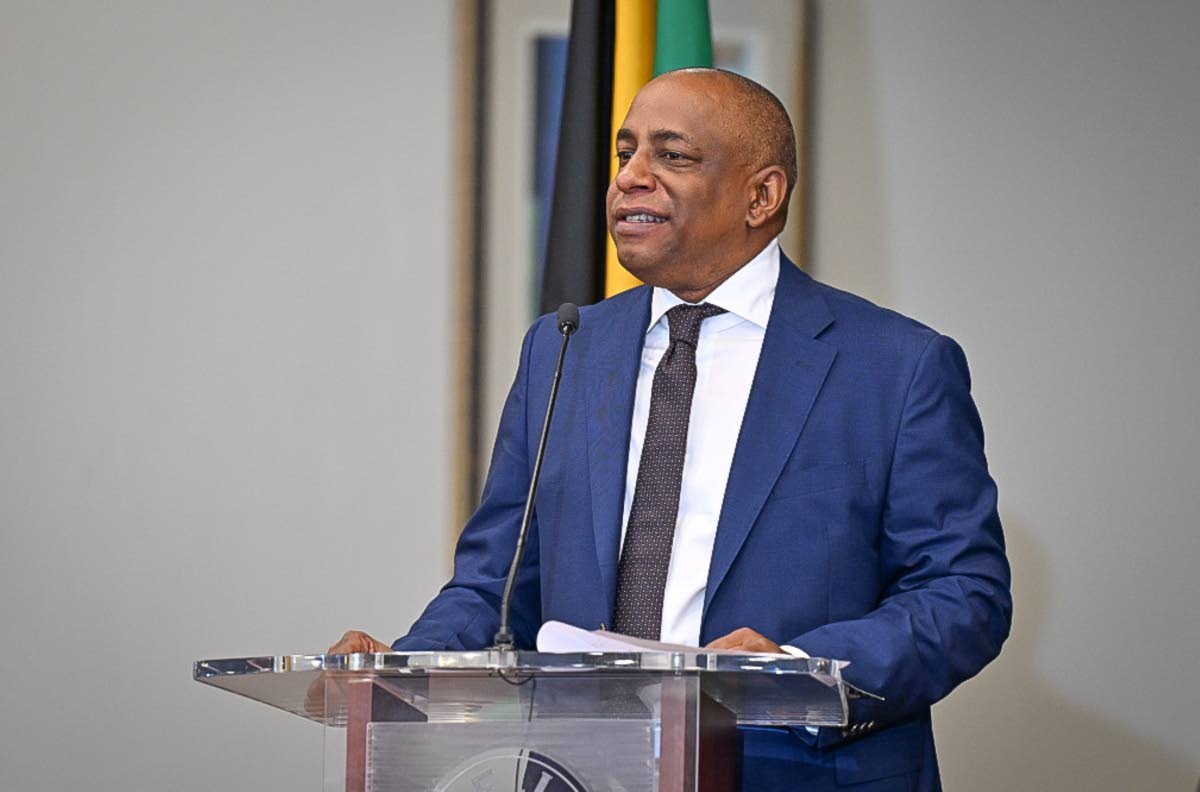 Dr Brian Langrin, newly appointed Governor of the Bank of Jamaica
-
 Janiel McEwan, economist and researcher
I read the news the way most Jamaicans probably did, on a phone screen, in the middle of an ordinary Monday.
The Gleaner's report was short, businesslike, the kind of article that states a fact and moves on to the next one.
Dr R Brian Langrin had been appointed the new Governor of the Bank of Jamaica, succeeding Richard Byles, and would take office on Wednesday, August 19, following appointment by the Governor-General in Council.
Two sentences.
A photograph of three people standing together. And yet I sat with that headline longer than its length warranted, because for me it was not simply news. It was confirmation of something I have believed for years about what a life in economics can become if it is lived with seriousness.
I want to be honest about what this admiration is and is not. I have never worked alongside Dr Langrin. I do not know him personally. What I know is his output, the working papers with his name on them, the record of two decades spent in the unglamorous machinery of financial stability analysis, the reputation he built inside institutions that do not reward flash.
That is admiration built on evidence, not proximity, and I think that distinction matters. It is easy to be moved by a title. It is harder, and more honest, to be moved by the labour that made the title possible.
WHY THIS ONE FEELS DIFFERENT
Jamaica has had capable governors before. But there is something particular about watching a career economist, someone who spent years producing research papers rather than running institutions, ascend to the top of the central bank. It is a reminder that technical depth is not a consolation prize for people who could not make it into more visible positions of power. It can be the very foundation of authority.
The Ministry of Finance's announcement, delivered through Minister Fayval Williams, described Langrin as a forward-looking leader whose experience spans Jamaica, the Caribbean and the wider development community, and pointed specifically to his grounding in monetary policy and financial stability as the qualities the moment demands. That is not the language typically used for a well-connected appointee. It is the language used for someone whose value lies in what he actually knows.
THE LONG APPRENTICESHIP
According to The Gleaner's report and Dr Langrin's own professional record, his path to the governor's office ran through more than two decades of central banking, financial stability work and multilateral development experience. He held senior positions at the Bank of Jamaica in financial stability and economic research, and he served as a Financial Stability Adviser at CARTAC, the IMF-administered Caribbean Regional Technical Assistance Centre, a posting that would have placed him inside the machinery of financial-sector surveillance across the wider region, not just within Jamaica's borders.
He holds a PhD in Economics from Pennsylvania State University, and he has published extensively on financial stability and monetary policy.
What strikes me most, reading through the trail of his research, is how early and how consistently the questions he asked anticipated the questions Jamaica would eventually need answered under pressure.
As far back as 2002, in a Bank of Jamaica working paper, he was building an early warning framework for the prevention of banking sector crises, years before the language of macroprudential regulation became standard in central banking. His later work examined how foreign exchange market shocks influence the way commercial banks allocate assets between domestic lending and foreign holdings, comparing patterns across Jamaica and Guyana.
Still later research explored how countercyclical capital buffers for Jamaican banks might be calibrated using conditioning variables that account for the build-up of sovereign risk, and how Jamaica's own sovereign debt exchange interacted with financial stability.
This is not the résumé of someone chasing headlines. It is the résumé of someone who spent a career asking what could quietly break the system before it broke, and then writing down the answer so that others could use it.
There is something instructive in that. The space between being a promising graduate student and being trusted with a nation's monetary and financial stability is not filled by ambition alone. It is filled by thousands of hours of unglamorous, careful, often invisible work, the kind that produces a working paper nobody outside a small professional circle will ever read, but that quietly builds the judgment a country will one day depend on.
WHAT A GOVERNOR ACTUALLY DOES
It is worth pausing here, because the significance of this appointment is easy to miss if one does not understand what the office actually controls.
The Governor of the Bank of Jamaica chairs the committee that sets the policy interest rate, the price at which money moves through the financial system, which in turn shapes what Jamaicans pay on mortgages, car loans, credit cards and business financing.
The Governor's decisions influence how much the Jamaican dollar is worth against the US dollar, which touches the price of imported food, fuel, medicine, and virtually everything else that arrives on a container ship.
The Governor stewards the country's foreign reserves, the buffer that allows Jamaica to withstand external shocks without a currency collapse.
And increasingly, the Governor is responsible for keeping the banking and financial system itself resilient, so that ordinary depositors never have to wonder whether their savings are safe.
None of this is abstract. When the Bank of Jamaica's Monetary Policy Committee decides to hold or move the policy rate, it is not an academic exercise. It is a decision that ripples into the cost of a bag of groceries in Half-Way-Tree, the interest on a small business loan in Mandeville, the affordability of a first mortgage for a young couple in Portmore.
Central banking, at its most honest, is not really about interest rates. It is about the credibility of the institution that sets them, and whether ordinary people can trust that the value of their money will not be quietly eroded while they are not looking.
THE MOMENT JAMAICA IS IN
Dr Langrin does not inherit a quiet economy. As of the most recent data available, headline inflation stood at 5.5 per cent in May 2026, near the upper edge of the Bank's 4.0 to 6.0 per cent target range, driven largely by the pass-through of higher global commodity prices tied to the conflict in the Middle East and by agricultural price pressures.
The policy rate has been held at 5.50 per cent through successive Monetary Policy Committee meetings this year, a stance the Bank has described as necessary to prevent second-round price increases from taking hold, even as growth for the current fiscal year is projected in the modest range of 1.0 to 3.0 per cent.
Private sector credit growth has moderated. International reserves remain healthy, and the exchange rate has held broadly stable, even showing marginal appreciation through the middle of this year. None of these figures describe a crisis. But together they describe an economy still absorbing shocks, from Hurricane Beryl in 2024 to Hurricane Melissa in 2025 to the 2026 oil price shock, while trying to hold the line on the hard-won price stability of the last several years.
That is the real question facing the incoming governor, and it deserves to be asked plainly rather than dressed up in celebration.
What kind of central banker does Jamaica need at a moment when external shocks keep arriving faster than the economy can fully absorb them, when credibility has to be defended quarter after quarter rather than won once and kept forever?
WHAT BYLES LEAVES BEHIND
Fairness requires acknowledging what Richard Byles built.
Over a seven-year tenure that began in August 2019, he guided the Bank through the COVID-19 pandemic, the global inflation surge that followed it, two major hurricanes, and the commodity shock of 2026.
Under his stewardship, the Bank strengthened its inflation-targeting framework and assumed full statutory independence under the Bank of Jamaica Amendment Act of 2020, a legal foundation that insulates monetary policy from short-term political pressure.
He also oversaw the launch of JAM-DEX, Jamaica's central bank digital currency.
The Government's own assessment, delivered through Minister Williams, was that he leaves the institution stronger and more independent than he found it. That is not a small legacy, and it is not one Dr Langrin should feel any need to distance himself from.
The task ahead is not to reinvent the Bank of Jamaica. It is to preserve the independence Byles secured, to extend the inflation-targeting credibility he built, and to bring the specific gift of a research economist, comfort with financial-sector risk modelling and macroprudential detail, to a Bank that will need both steady hands and sharp technical judgment in the years ahead.
WHAT THIS MEANS FOR SOMEONE STILL FINDING HIS PLACE
I am still early in this profession. I have not run a research division. I have not sat inside the institutions where monetary policy is actually made.
What I have is curiosity, a habit of reading more than I am asked to, and a growing appreciation for how much distance separates knowing economic theory from being trusted to apply it under pressure, on behalf of people who will never read the paper you wrote but will feel the consequences of the decision you made.
Watching Dr Langrin's career, what I find myself admiring is not the title he now holds. It is the discipline of the path that led to it.
Two decades inside institutions that do not offer public recognition for careful work. Papers written on early warning systems and capital buffers, subjects most people will never encounter, but that quietly determine whether a banking system survives a shock or does not.
A doctorate earned not as decoration but as a tool sharpened for a specific kind of usefulness.
That is a version of ambition I find worth aspiring to, ambition measured not by how quickly one rises, but by how thoroughly one becomes capable of carrying the responsibility once it arrives.
A WORD TO THE NEXT GENERATION
To the young Jamaicans studying economics, finance, statistics, mathematics, public policy and data science right now, I would only say this. Excellence in this field is rarely built in public. It is built in the quiet accumulation of reading you were not assigned, questions you kept asking after the lecture ended, data you sat with until it told you something true rather than something convenient, and criticism you learned to absorb without either collapsing under it or dismissing it.
Jamaica does not need more people who can recite the vocabulary of economics fluently at a dinner table. It needs people who can sit with a spreadsheet of banking data for a decade and notice, quietly, the pattern that could one day prevent a crisis.
It needs economists who can hold theory and lived reality in the same hand, who can explain a policy rate decision to someone standing in a supermarket line without condescension, and who understand that the point of the work is never personal recognition but the steadiness of the system other people depend on.
THE BIGGER QUESTION
Dr Langrin's appointment should not be read as a finished story or a guarantee of success. Admiration for a career is not the same as certainty about a tenure.
The real tests are still ahead.
• How will the incoming governor respond if inflation, already brushing the upper edge of its target range, refuses to recede on schedule?
• How will he balance the discipline of price stability against an economy still growing modestly and still recovering from consecutive shocks?
• How will the Bank communicate difficult decisions to a public that feels monetary policy through their grocery bill long before they understand it through a press release?
These are not rhetorical questions. They are the actual weight of the office he now occupies, and Jamaica is right to expect answers, not applause.
But there is a question underneath all of that, larger than any single tenure: What kind of economists does this country need to produce over the next generation?
Not merely more people with the credentials, but people capable of independent thought, honest with data even when the data is inconvenient, unwilling to trade intellectual integrity for comfort or applause, and serious enough about the work to spend years on questions that will not make anyone famous.
Some careers inspire admiration because of the positions people eventually come to hold. Others inspire something deeper, because of the person the work quietly required them to become long before the title arrived.
I am still learning which kind of economist I want to be. But watching Dr Brian Langrin's road from a research desk to the Governor's chair, I know now what the standard looks like. Not a title reached, but a mind made worthy of what the title demands.
- Janiel McEwan is an economist and researcher. Email feedback to janielmcewan17@gmail.com and columns@gleanerjm.com. ONLINE ONLY COMMENTARY.