Neil Richards | New parliament building may be ideal at Caymanas
Loading article...
-
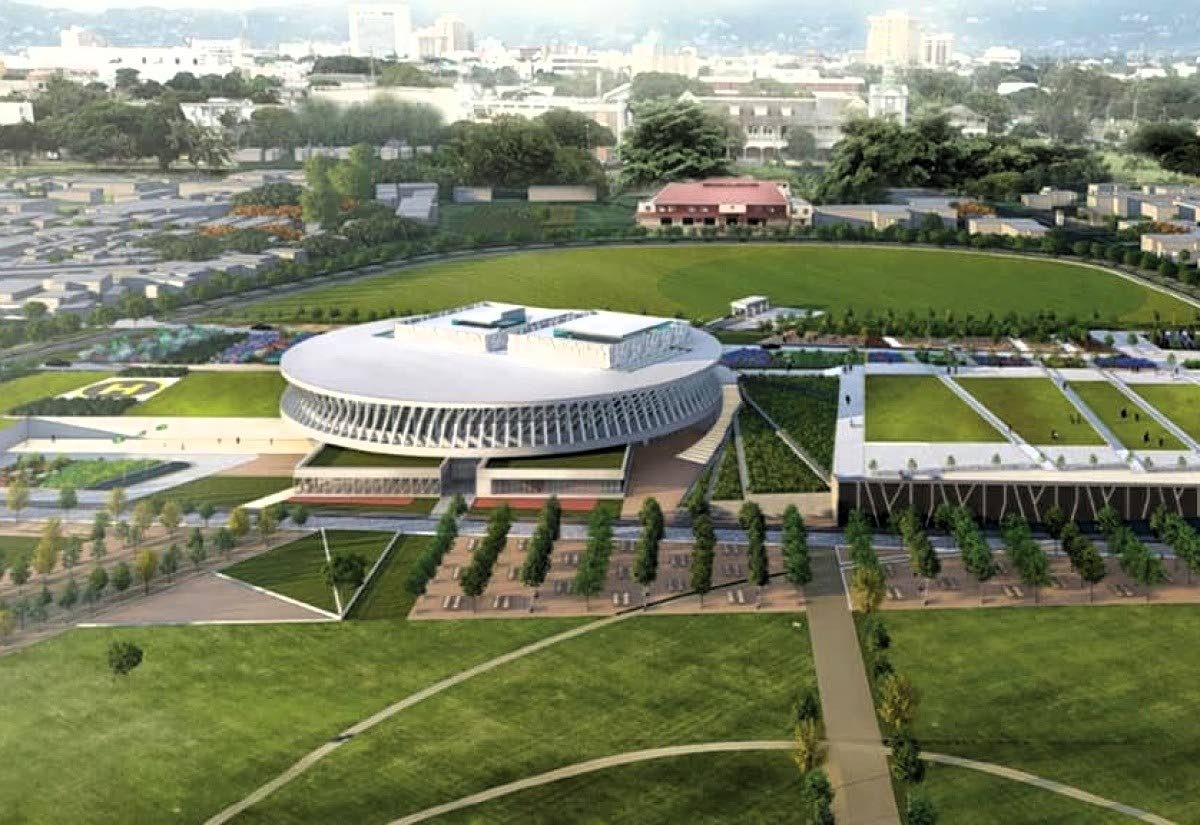 An artist’s rendition of the design concept of the proposed new parliament building.
-
 Neil Richards
There are good reasons to re-assess and perhaps retract the decision to construct a new parliament building within the confines of National Heroes Park. Troubling predictions, related mainly to forecasts of intractable road traffic flows, warrant a review and possible reversal of its selection.
Speculation that a site in northeast St Andrew has qualities that justify its selection as an alternative location for that project is an expectation that will not materialise. A recent official announcement to the contrary has ‘thrown out’ that possibility when it was affirmed that the future of that ‘green space’ will be as an area to be used for particular public recreation.
Definitely not in contention for selection is the expansive Up Park Camp premises, because of numerous physical and other impediments there. Perhaps the most forbidding of the impediments is the prospect of massive dislocation of that key facility.
Selection of a site for a parliament building outside the municipal boundary of any nation’s capital city would be quite extraordinary and perhaps unprecedented. That prospect looms in Jamaica and may come into effect if rational considerations prevail.
An overview of site-location options for that project points to Caymanas as a potentially viable site for Jamaica’s future legislative chamber.
The physical distance of Caymanas from key central government infrastructure is a clear existing disadvantage. That factor is a predictable reason for disagreement and immediate outright rejection of its worthiness for selection. The challenge is to tame and perhaps conquer that disadvantage.
WHY NOT NATIONAL HEROES PARK?
The fundamental reason that National Heroes Park is not a desirable location for the construction of a parliament building stems, it seems, from the failure of successive governments to pursue a bold mid-20th century land-use initiative. That initiative was a farsighted urban development strategy to assemble many parcels of land beyond the eastern and southern periphery of National Heroes Park for future central government offices and other public sector installations.
That proposal would arguably have enabled a sufficient land reserve to construct a future parliament building with supporting facilities within the Heroes Circle precinct.
Predicted heavy traffic volumes that would be generated by a parliament building in the park would retard general traffic flow and diminish the environmental quality of the immediate surroundings.
Vehicular movements related to the Wolmer’s schools, the Mico University College ,and other established entities in that precinct would contribute significantly to the congestion. Also, add traffic originating from and destined for downtown Kingston.
A mild symptom of the ‘gridlock’ that is likely within the environs of a Heroes Park parliament site is the routine diversion of normal traffic flow when there is a sitting of Parliament at Gordon House on Duke Street.
Very significant capital investments in road-access solutions and other civil-engineering infrastructure would be necessary to satisfy anticipated demand for those essential and highly technical municipal services.
What, then, should be the future of National Heroes Park?
(a) At its southern end, land conservation should be pursued by reducing the size of future memorial displays.
(b) Land in the northern sector, now in use as an extensive parking lot for motor vehicles, should be restored to its original public open-space and recreational use.
KING’S HOUSE LAND
Commentary in the media which advocated the use of land in northeast St Andrew as the site for Jamaica’s future Houses of Parliament is now a confirmed defeated prospect.
That site, which borders East King’s House Road, will be, or is now, zoned in its entirety for recreational use.
That designation, if faithfully and properly implemented, will ‘go a far way’ in reducing the growing shortage of public open space in the northeast St Andrew precinct, where municipal engineering infrastructure along the Lady Musgrave Road and East King’s House Road corridor is overloaded. The unexpected, massive increase in residential and commercial densities in that sector of St Andrew justifies the recent public open-space designation. Recreational activity there will be a fitting public open-space companion to the intensely used Barbican playing field not far to the north.
Major disadvantages and other hindrances affecting the selection of a site for a parliament building within Kingston and St Andrew justify a site-selection quest outside the boundary of the nation’s metropolis.
Several positive factors indicate that the best prospect in that quest lies midway within the ‘soon-to-be-integrated’ Kingston and South St Catherine metropolitan region, where Caymanas is situated.
Resolving current vehicular-access impediments and improving time-management efficiencies are the keys to making Caymanas an infinitely better alternative to National Heroes Park.
In the event that a Caymanas location wins favour, the competition-winning design for a parliament building at National Heroes Park would require site-planning and other functional adjustments. The aesthetic character of the required changes should, of course, be designed by the prize-winning architect for that project.
Opportunities seem to abound at Caymanas for the good spatial integration of a new legislative chamber with adjunct facilities that should include a heliport to facilitate efficient intra-island travel. Such a rapid-transit facility would be the ideal alternative to road access, but its economics would apparently require group travel and good time-management discipline.
The current objective of constructing a new parliament building at National Heroes Park should be re-assessed.
Caymanas is an alternative that beckons to be examined and perhaps selected.
Neil Richards is an architect and town planner. Send feedback to columns@gleanerjm.com.