Airbnb pledges $500m to non-profit, scaling emergency stays and raising questions over housing relief
Loading article...
-
 AP
Airbnb CEO Brian Chesky arrives at the Airbnb Gala on Wednesday, October 28 at Milk Studios in Los Angeles. Photo - AP Jordan Strauss
-
AP
Airbnb CEO Brian Chesky arrives at the Airbnb Gala on Wednesday, October 28 at Milk Studios in Los Angeles. Photo - AP Jordan Strauss
-
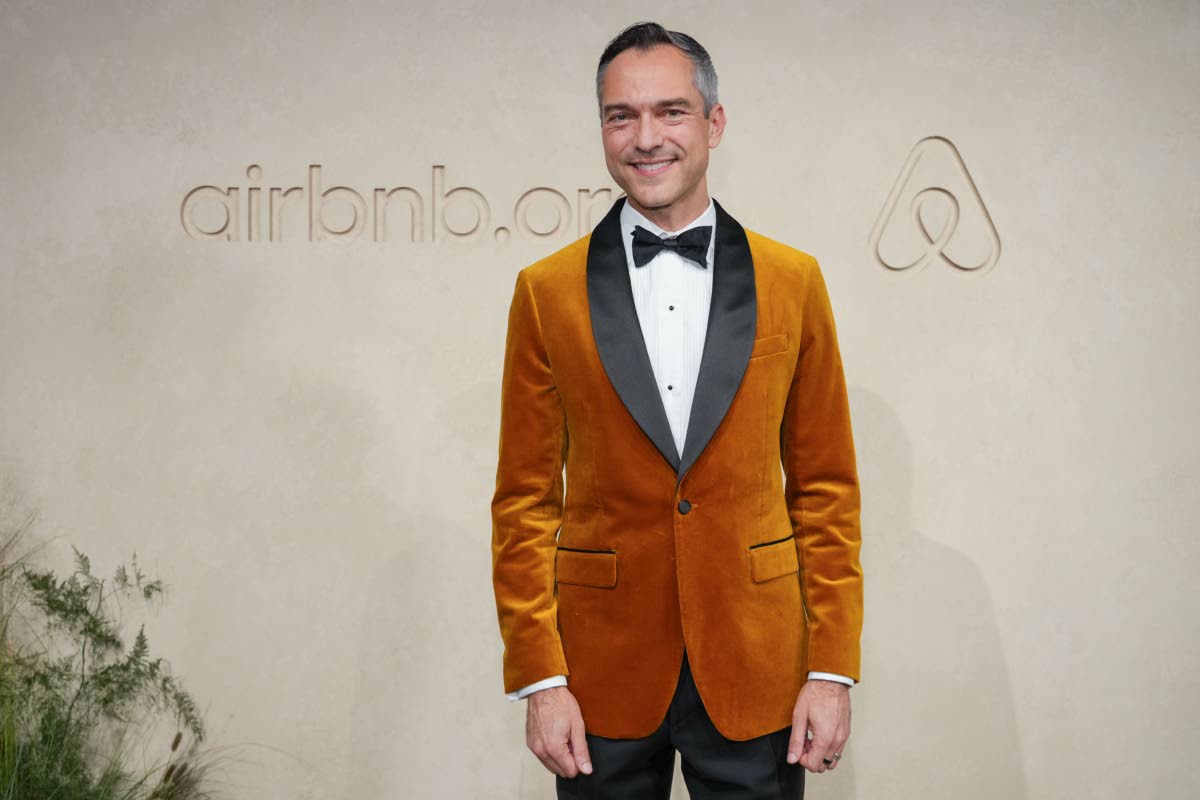 Airbnb co-founder Nathan Blecharczyk arrives at the Airbnb Gala on Wednesday, October 28 at Milk Studios in Los Angeles. AP. Photo - AP Jordan Strauss
Airbnb plans to dedicate US$500 million to its philanthropic arm over the next five years to increase temporary housing support for medical travellers and disaster survivors.
The short-term rental platform will fund the expansion by donating 10 cents from every booking and make up any shortfall, according to Airbnb CEO Brian Chesky. Airbnb.org, the independent non-profit whose operating costs are already covered by the company, aims to scale up to eventually provide 1 million nights of free housing each year.
The pledge, announced on Wednesday, arrives at an uncertain time for corporate philanthropy overall. Most companies reduced their giving over the past five years, according to a recent survey by Chief Executives for Corporate Purpose. Tax law changes have prompted businesses to reconsider their charitable strategies.
Airbnb.org’s new funding model has resurfaced questions about the charitable endeavours of a corporation criticised by some affordable-housing advocates for worsening the supply of lower-cost, residential housing. The affordable-housing crisis — which critics say is exacerbated by Airbnb — means less housing is available for people displaced by disasters.
Should a for-profit enterprise use its philanthropy to offset less desirable business impacts? Leading artificial intelligence companies, currently sketching out plans to share some of their wealth, say yes.
For Chesky, the answer is emphatically “no”. He denied Airbnb is “the contributor of the reason cities are expensive”, but acknowledged that some hosts take a small fraction of their area’s housing off the market. This week’s commitment is about doing the “right thing” with the company’s “natural superpower”, he said.
“I don’t like this idea that somehow you create a non-profit to make up for, or apologise for, your core business,” Chesky told The Associated Press. “Our core business, independently, is gonna affect a lot more lives than this organisation. And our core business needs to be responsible. And if we’re doing something that’s not responsible, we need to correct it.”
Many governments, including the country of Spain and the city of New York, have recently moved to curb short-term rentals. The company could use its growing philanthropic footprint to further ingrain its product into communities and legitimise the presence of short-term rentals as its model is contested, according to Karolina Mikołajewska-Zając, a postdoctoral fellow at Copenhagen Business School who researches the societal impacts of digital platforms. She cautioned the humanitarian sector against growing too dependent on commercial platforms.
Murray Cox, the founder of the data activist project Inside Airbnb, noted one “crisis” missing from the non-profit’s list of emergency housing interventions.
“There’s also the housing crisis that’s occurring around the world,” Cox said. “And, although they’re not causing the housing crisis, they’re contributing to it by taking millions of housing units — residential houses — off the housing market.”
Airbnb.org is squarely focused on short-term emergency housing. Launched formally in 2020 as the San Francisco-based company went public, the non-profit uses company-donated credits to book stays on its platform for those experiencing crises. Since then, the non-profit reports having provided 1.6 million nights of free, temporary housing in nearly 140 countries. Fees are dropped and hosts are compensated. The non-profit also provides credits for other relief organisations to book stays.
Beneficiaries include people recovering from natural disasters, families travelling for medical care, and survivors escaping domestic violence. When Washington state wildfires forced tens of thousands of evacuations in August, Airbnb.org said it provided more than 1,400 nights of free housing in the disaster’s early days.
Christoph Gorder, executive director of Airbnb.org, compares the non-profit to “the ambulance that’ll get you to the hospital”. Short-term housing is a “great product-market fit,” he said, because they’re able to “house a lot of people very quickly with an enormous amount of flexibility to meet their particular needs”.
He emphasised that the new funding mechanism will provide a “lot more money” that the non-profit can depend on each year. “It’s not just shuffling the deck chairs around,” he said.
The US$500-million, five-year injection would more than double the total contributions reported by Airbnb.org between 2021 and 2025. The company would have to register 5 billion bookings over the next five years to reach that figure through the sliver of each booking donated to the non-profit.
Chesky emphasised that the commitment will be completed regardless of business outcomes.
“We felt like this is a responsible number, where it’s sufficiently big to make a difference in the world,” Chesky said. “But it’s also a number shareholders can be comfortable with.”
Short-term assistance from non-profits, such as Airbnb.org, and government entities, such as the Federal Emergency Management Agency, are “key for preventing that initial displacement”, according to Noah Patton, the director of disaster recovery at the National Low Income Housing Coalition. That’s especially so as an AP analysis showed President Donald Trump takes longer to approve disaster aid and denies a greater percentage of requests than his predecessors.
But Patton said there’s a need for more lasting solutions so “folks have homes to return back to”.
“It’s a Band-Aid if you don’t also focus on the long-term aspect of this,” he said.
Expanding options for medical stays
Airbnb.org will also expand its medical stays programme to 20 countries by the end of the year.
The non-profit partners with medical relief organisations to provide housing for families travelling to get treatment. Airbnbs, according to Gorder, allow families to bring additional relatives and pets that some alternatives don’t allow. Amenities such as kitchens, sometimes not available in hotels or hospital lodgings, give the option to cook patients’ favourite foods.
“And then they just have a quiet place at the end of the day,” Gorder said. “So, it’s a lot more than four walls and a roof.”
In Mexico, where the programme was piloted last fall, Airbnb.org says it has housed medical travellers for nearly 1,500 nights. Its first partner, Vuela Fundación, supports children diagnosed with cancer. Many of the Mexico City-based organisation’s clients travel from poor rural towns and lack access to the country’s social security system.
Diego Parada Herrera, the co-founder and CEO, said it’s not uncommon to see families camping in tents or sleeping in parked cars outside of hospitals because they couldn’t afford to stay anywhere else.
“The need was there. And we were conscious of it,” he said. “But we didn’t know how to address it.”
Airbnb.org now provides his organisation with credits that case managers use to complete bookings for families in need. Some hosts offer discounted rates, he said. Vuela Fundación stocks fridges with ready-to-cook food packages.
The challenge, he’s found, is that many families aren’t technologically savvy. Some aren’t familiar with Airbnb’s business model and struggle to grasp that they’ll be staying in someone else’s home. His non-profit created instructional videos and shows them how to use the platform.
Chesky said the company will likely “keep going” based on how this expansion goes.
“Whatever people think of us, we’re doing this for decades,” he said. “It’s up to them to judge us and our motivations. And it’s up to us to have a commitment that’s a decade-long commitment.”
-AP