CMU team wins inaugural Engineer’s Tank competition
Loading article...
-
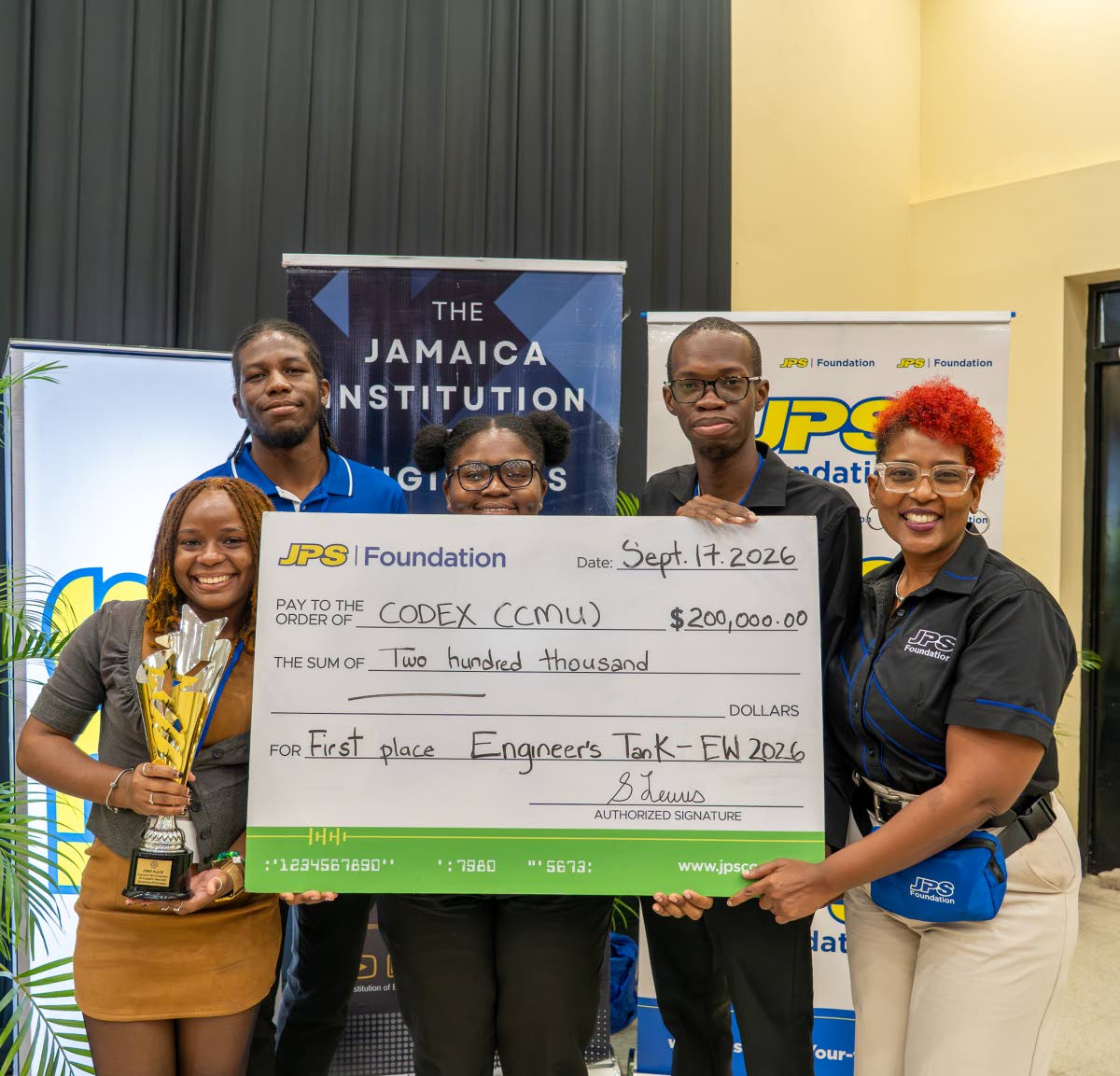 JPS Foundation Head, Sophia Lewis (right) presented the symbolic winning cheque of $200,000 to the first-place team from Caribbean Maritime University (CMU) which won the inaugural Jamaica Institution of Engineers’ Engineer’sTank pitch competition which was sponsored by the Foundation. The winning CMU team comprised (from left to right) Kenya Reid, Kyle Powell, Nickajae Warburton and Nashe Blake, also referred to as CodeX. The competition took place at the University of Technology. Photo - Contributed
-
JPS Foundation Head, Sophia Lewis (right) presented the symbolic winning cheque of $200,000 to the first-place team from Caribbean Maritime University (CMU) which won the inaugural Jamaica Institution of Engineers’ Engineer’sTank pitch competition which was sponsored by the Foundation. The winning CMU team comprised (from left to right) Kenya Reid, Kyle Powell, Nickajae Warburton and Nashe Blake, also referred to as CodeX. The competition took place at the University of Technology. Photo - Contributed
-
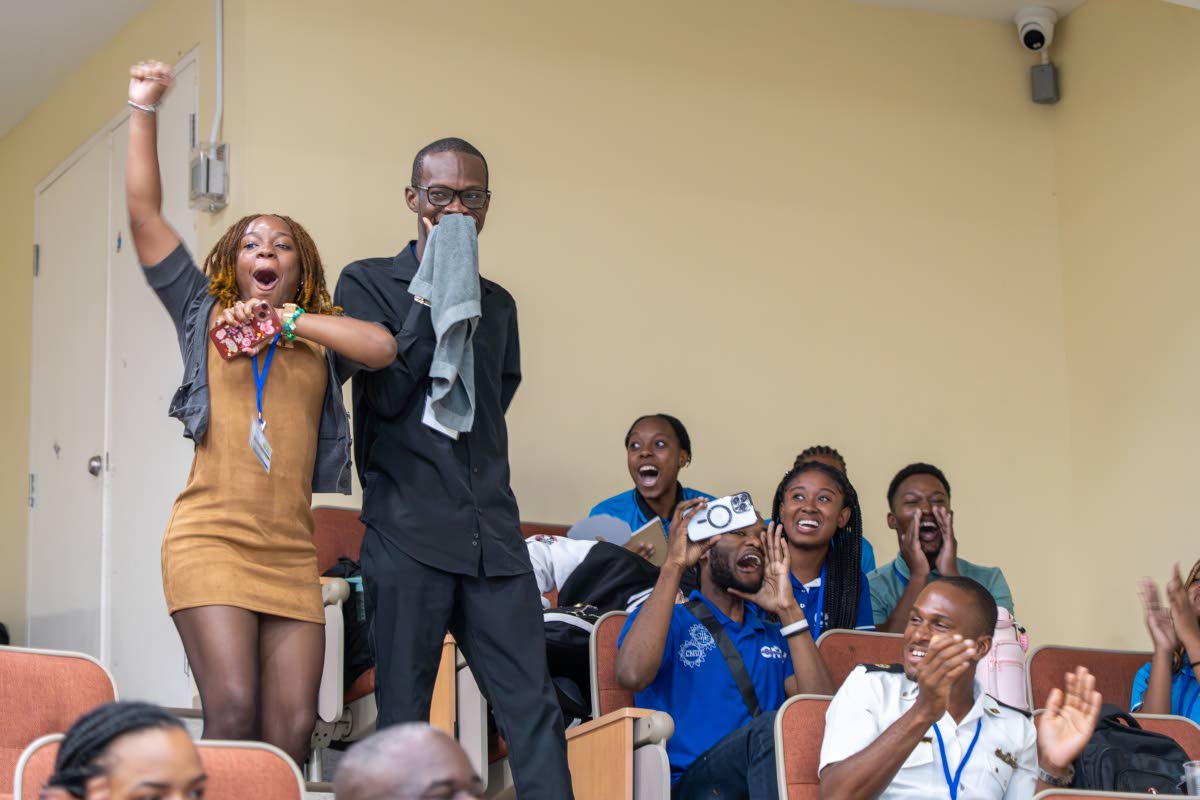 Caribbean Maritime University engineering students Kenya Reid (left) and Nickajae Warburton joyously react to their four-person team, CodeX, being announced the winners of the inaugural Engineer’s Tank pitch competition hosted recently by the Jamaica Institution of Engineers. Photo - Contributed
-
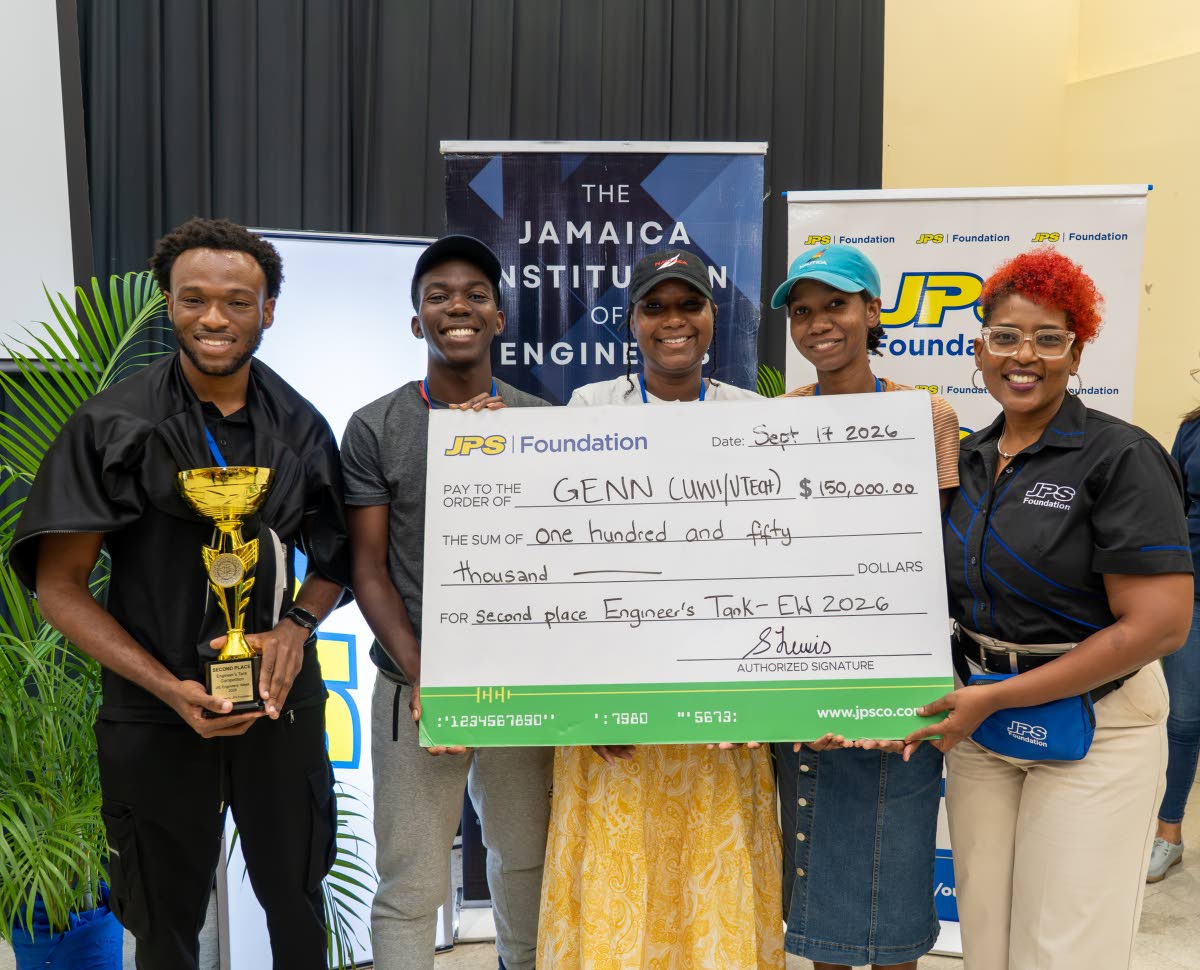 Second place honours in the recently staged Jamaica Institute of Engineers’ Engineer’s Tank pitch competition went to a joint engineering team GENN from the University of Technology and the University of the West Indies. JPS Foundation Head, Sophia Lewis (right) presented the team of Jovanni Spence, Everton Smith, Natania Beavers, and her sister Nicolette Beavers with a cheque that represented their first runner up prize of $150,000. Photo - Contributed
Gripped by momentary disbelief, Nickajae Warburton covered his mouth as he registered his team’s victory in the Engineer’s Tank competition.
“It was a shock at first, but we were thrilled with the results,” a visibly excited Warburton shared moments after claiming victory alongside his Caribbean Maritime University (CMU) teammates, as cameras clicked away.
The 21-year-old aspiring mechatronics engineer was a member of the four-person winning team, comprising Kenya Reid, Kyle Powell and Nashae Blake, who dubbed themselves CodeX.
For their efforts, they won $200,000 in the JPS Foundation-sponsored Engineer’s Tank pitch contest.
The inaugural staging of the competition, mounted recently by the Jamaica Institution of Engineers (JIE) at the University of Technology, Jamaica (UTech), saw seven teams make their pitches through presentations featuring visual aids and prototypes.
Tertiary students from CMU, UTech, Northern Caribbean University and The University of the West Indies (UWI) competed for the top three places.
A joint UWI-UTech team, which adopted the moniker GENN, secured $150,000 as first runner-up. Third place and $100,000 went to the CMU team Agro Engineers.
“Seeing our team efforts being acknowledged as the winner felt amazing,” beamed Warburton, a third-year student in CMU’s Faculty of Engineering and Applied Technology.
Team CodeX topped the judges’ scorecard with its pitch for what the students coined the Smart Tank IoT.
Explaining the possibilities of their prototype, Warburton said it was an automated water controller designed to be installed on residential black water tanks. The artificial intelligence-assisted controller was conceived to detect and report the percentage of water remaining in a tank while also analysing the water’s quality.
“We developed the concept in late August. It was a rapid sprint as we built a quick proof of concept to validate the hardware, then spent the final days perfecting our business case and pitch,” he said of the preparation process, which began after the JIE invited submissions from interested tertiary-level engineering students about a month ago.
Warburton’s teammate, Kenya Reid, said the group’s brainstorming sessions around the water tank controller involved research and “thinking about real life situations we have to encounter especially given the water crisis we have now.”
She explained that their approach was to modernise the traditional black tank.
“We put that in perspective. We thought of how when you have a tank up to three months, it accumulates residue, so the Smart Tank device we created could test and alert you if the [tank] water is clean and good to use,” Reid pointed out.
Now in her third year of studying mechatronics at CMU, Reid hopes to become either an agricultural or biomedical engineer.
She said the prototype, if manufactured and brought to market, “would primarily be aimed at family households and small businesses because of the day-to-day demands they face.”
For Team GENN, whose name was derived from its members’ first initials, 21-year-old Everton Smith said “us placing second was greatly appreciated, and validated the work we put out for the competition”.
Comprising sisters Natania and Nicolette Beavers, Jovanni Spence and Smith, GENN presented its FarmerShield prototype to the judging panel.
The system is designed to collect and store water for agricultural use.
“During the wet season, we would set up the system, in which we have a reservoir below agricultural land. Then in instances when there is an extended dry period, FarmerShield would become operational as an irrigation tool outfitted with pumps and a filtration system to provide water to crops in the field,” Smith explained.
Originally from Manchester, Smith commutes daily from the hilly parish to UTech in St Andrew.
“Where I live, I’m overlooking farm fields and since early summer, no one has been able to plant anything because of the lack of water. The FarmnerShield system would be perfect to work. It is designed where the reservoirs to be used are at the bottom of hills and pumps are at the top. When collecting water, gravity will have the water come down through pipes, and have the system pump back up,” he explained.
Jayann Walters, JIE vice-president with responsibility for partnership and education, was impressed by Smith’s FarmerShield prototype and the other innovative ideas presented by the engineering students.
Walters conceived the Engineer’s Tank competition, which is modelled on the popular reality television show Shark Tank, in which entrepreneurs pitch business ideas to a panel of potential investors.
“I was very pleased with the content and execution of the team presentations. I was happy they connected it to real-world problems,” she said, noting that some prototypes offered potential solutions to disaster recovery challenges and water shortages.
“A lot of the teams focused on agriculture resilience and food security which is very important. I think a lot of times people don’t connect farming and agriculture to engineering. It shows the students are thinking about the places they are from, and the challenges we are facing and how they can apply technology to fix them,” said Walters, a process control engineer employed at bauxite company Jamalco.
JPS Foundation Head Sophia Lewis said supporting the JIE’s student-focused engineering pitches was an overwhelmingly positive experience.
“This is more than sponsorship of an event, it is an investment in ideas and an investment in young people,” she said of the Foundation’s decision to financially support the inaugural competition.
Highlighting the connection between JPS engineers and the next generation of professionals pursuing related degrees, Lewis said: “We want to ensure that we have quality engineers who are coming out of the system, so it is really a pleasure for us to support this venture.”
With science, technology, engineering and mathematics (STEM) education a key focus area for the JPS Foundation, Lewis said supporting the Engineer’s Tank contest was an easy decision.
“We believe when we encourage young people to think critically and give them opportunities to create, we are helping to create a framework where they are the problem solvers our country needs for tomorrow as innovation is where the future lies.”
In addition to supporting the tertiary-level Engineer’s Tank competition, the JPS Foundation hosts an annual Innovation Challenge for secondary school students, with cash incentives for the winning teams.
The Foundation also operates more than 50 Power Up Energy Clubs in high schools across the island.