Tony Deyal | Nostalgia News Report 1945 to now!
Loading article...
-
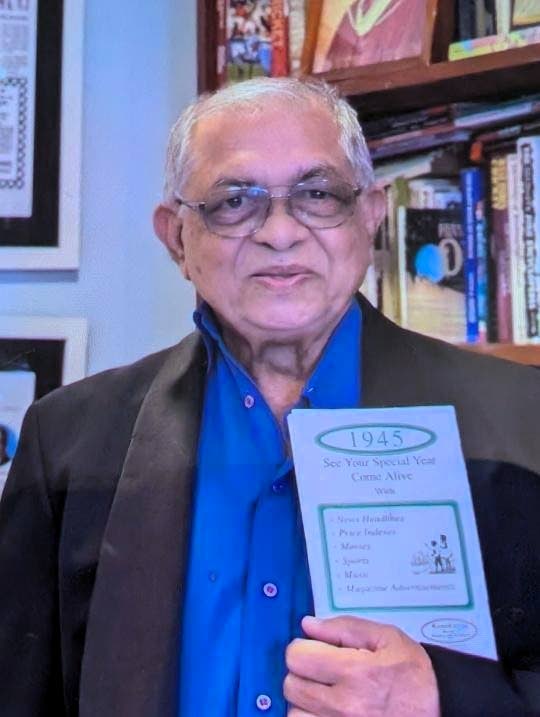
Tony Deyal with a copy of 1945 Nostalgia News
-
 Tony Deyal
(For my wife, Indranie Deyal, who gave me the 1945 Nostalgia News Report)
I was born on August 10, 1945, in a small town called Carapichaima in Trinidad and Tobago, where we lived with our extended family. The head and leader, our mother, had a small place for herself.
Then our aunt, with her three children, occupied one small part; our uncle had his wife and son in the second; and my father and mother, along with me, had the last. My mother, Margaret, came from a different area of the country, and to celebrate the “baby” boy (me), my father, Dipchan, held a big “lime” with the families and many, many friends. As usual, rum was the centre of the conversation.
Fortunately, I fell asleep. But when I woke up, I found out that all the ladies had held me, played with me, and told the others, “What a lovely boy. I wish I had one like him. Yes! He is so nice!”
That didn’t last long because this “baby” very quickly became a “boy” who was not easy, especially with his older cousin in the next room. We played most of the time, but sometimes we fought with each other, either joining together to go after the other boys in the area or going after each other, especially when food was not shared equally in the house.
What I loved more than anything else was the mix of people in our area. Regardless of race and class, they got along like friends, and, most times, even family. The reason was very simple. We were all there because of the sugar-cane estate. Most of the men and women, even the children, regardless of race and colour, worked morning to night, Monday to Sunday.
The women had it much harder. They, and the men, went from very early in the morning to start cutting cane. The men, however, had a drink or two before they headed to work. But not the women. They had to be there from the start. Then after they finished their tasks, the men went to the shop for more rum while the women had to rush home to cook and get their children ready to go to school.
Our family not only had to eat together but also had to plant our own rice as well as potatoes, spinach, and any fruit we could grow on our land. I remember when I was five, I had to help and protect the “paddy”, which is really a flooded field where rice grows. My job was to have a big stick and shout at the birds coming to “thief”. If they won, I lost, and everybody in the house gave me some “hard talk” for days until my cousin made the same mistake.
Later, my father and a few other people in the area had shops under their houses. Like the others, my father had the rum section, and my mother sold food and home essentials. However, my father drank more than he sold in the rum shop.
Fortunately, my mother was in charge of the non-alcoholic side where she very quickly linked up with the women customers who gossiped about everything, everybody, and every day. I was chased off by my father with the “limers” drinking rum and by my mother, who didn’t want me to hear about the “bachanal” (as she called it).
Fortunately for the other boys and me, we rushed outside to play cricket and football as well as look for anything to eat, even sugar cane.
As I started at school, and then later as a teacher, I got a gift from my wife documenting news headlines from 1945, the time when I was born. She gave me Pages of Time, which was a “Nostalgia News Report”.
Next Monday, I will turn 81, and I decided to look back at what it was like then. The first page was “World News”, and I can tell you it was scarier than now.
“Atomic Bomb Destruction Ends War with Japan” topped the page, followed by “Germany Surrenders to Allied Forces May 7th”. Then there was “Americans Cross Rhine at Remagen”.
The rest was not better. There was “Mussolini Executed. Hitler Victim of Suicide”.
I found out that Mussolini was the Italian strongman who led Italy as a fascist dictatorship and an ally of the infamous Austrian-born demagogue Hitler, who triggered World War II by ordering Germany’s invasion of Poland in 1939.
Then we heard that “American Flag Raised Over Iwo Jima” meant it was nearly over. That report referred to the iconic Joe Rosenthal photograph for the Associated Press of six United States Marines raising the flag atop Mount Suribachi in Japan during the final stages of the Pacific War. It won the 1945 Pulitzer Prize for Photography.
Another memorable headline was “The US Extends 400 Million Dollars In Aid To Greece and Turkey”. That meant that the US shifted from isolation to a policy of containing Soviet influence and stopping the global spread of communism.
However, what was worse was that the average American income was about US$2,400. This was against the average national income in Trinidad and Tobago and most of the Caribbean. They had roughly $240 annually in colonial currency. However, actual earnings varied widely by job, race, and sector.
Field labourers, like my father, on sugar and cocoa estates earned very low weekly wages, often only a few dollars a week. Those lucky enough to be employed on the American military bases, or in town, got higher amounts, ranging from $30 to $100 each month.
A loaf of bread was less than 10 American cents. It compared to one cent for my all-time favourite Trini “hops bread”. Milk averaged about $1.20 per gallon, rising from 44 cents due to wartime production costs. We bought fresh milk when we could for about 12 cents a pint.
Fortunately, there were other Pages of Time memories fr om 1945 to make up for the major problems that increasingly put us under pressure.
Looking closely in the Pages, I found “The Most Famous Calypso of 1945!” This was Lord Invader’s “Rum and Coca Cola”, which gained massive international fame when the Andrews Sisters remade it and took it to number one on the American charts, sparking a major copyright legal battle.
Originally composed and recorded to reflect the social impact of American servicemen stationed in Trinidad, its crossover success defined the global footprint of calypso in 1945.
The rise of Lord Kitchener was rapidly expanding his prominence in Trinidad’s local tents during this post-war period, setting the stage for his golden era. Then the iconic Lord Melody made his official calypso tent debut in 1945 before joining the prominent Victory Tent.
Then, although official street carnivals were suspended from 1942 through 1945 due to World War II, calypso tents remained active spaces for vital local storytelling and commentary.
What I finally found was something that I really loved. It was when my wife and I read the special 1945 songs.
It started with “AUTUMN SERENADE” and then “IT MIGHT AS WELL BE SPRING”. Then there was one from my days in the United States, “NEW YORK, NEW YORK!”
However, nothing comes close to the one my wife and I love morning, evening, and especially night: “YOU’LL NEVER WALK ALONE”.
Tony Deyal read that the 1945 life expectancy was 62.9 years, but at 81, he is hoping for many more years of hops, milk, and, most of all, his beloved wife, Indranie. Send feedback to columns@gleanerjm.com.