Clarendon first parish to formally integrate migration into long-term growth framework
Loading article...
-
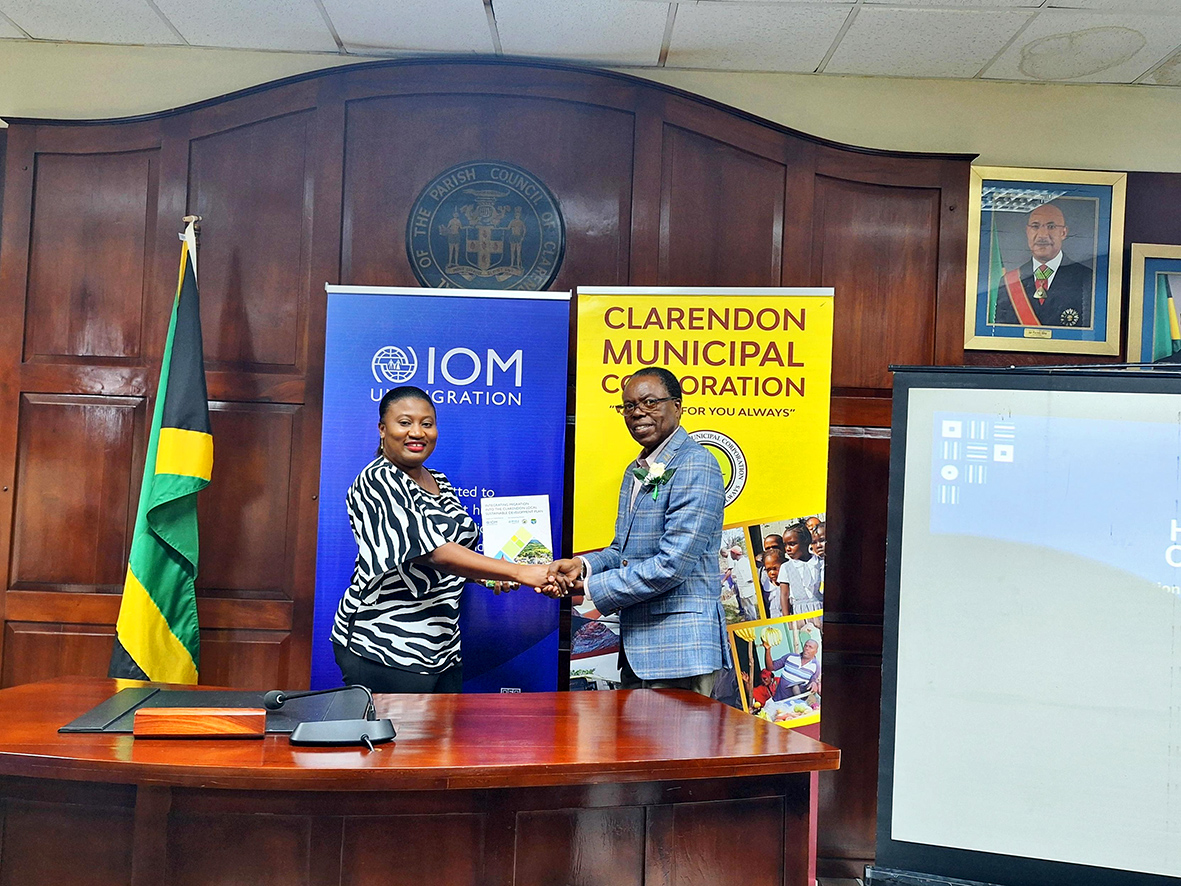
Natasha Greaves, head of office, IOM Jamaica, and Mayor of May Pen Joel Williams during last Thursday’s handover ceremony for the migration chapter of the Clarendon Local Sustainable Development Plan (CLSDP) at the Clarendon Municipal Corporation.
-
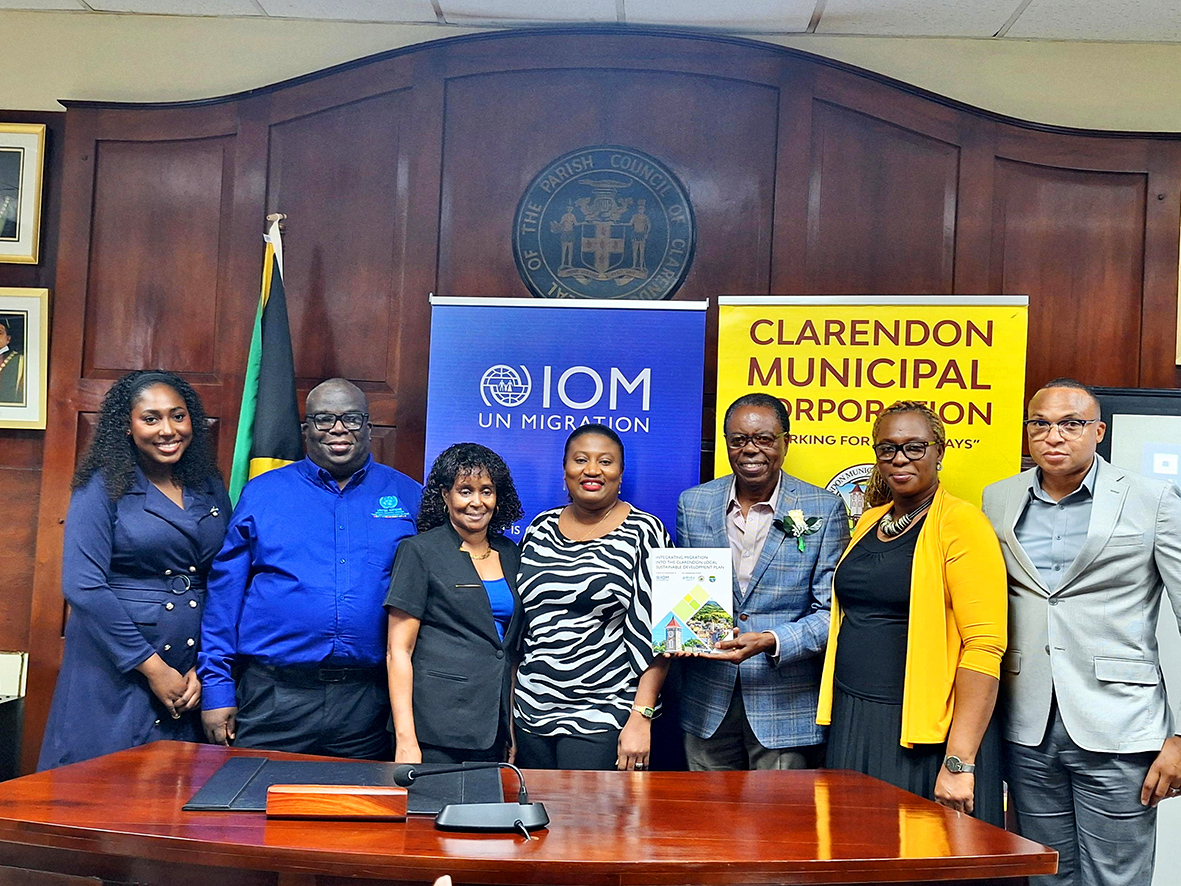
From left: Krystal Lofters, national programme officer, IOM, Jamaica; with Dennis Zulu, United Nations resident coordinator; Eurica Douglas, general manager, Clarendon parish development committee; Natasha Greaves, head of office, IOM Jamaica; Mayor of May Pen Joel Williams; Antonette Richards, programme director, civil registration & migration, PIOJ; Rowhan Blake, CEO, Clarendon Municipal Corporation.
Clarendon has emerged as a national leader in local development planning, becoming the first parish in Jamaica to formally integrate migration into its long-term growth framework—a move officials say signals a fundamental shift in how communities plan for the future.
The milestone was marked last Thursday, during a handover ceremony for the Migration Chapter of the Clarendon Local Sustainable Development Plan (CLSDP) at the Clarendon Municipal Corporation (CMC). The initiative represents a strategic partnership between the International Organization for Migration (IOM) Jamaica, and the CMC, aimed at ensuring migration is no longer treated as an afterthought, but as a central driver in positioning Clarendon as a parish of choice.
Originally launched in 2017, the CLSDP serves as the parish’s blueprint for sustainable growth, developed through a bottom-up approach that placed residents, community groups, and local stakeholders at the centre of decision-making. However, a gap analysis later revealed that migration, despite being a major engine of development, was not adequately reflected in the plan.
The newly developed migration chapter addresses that omission through the project ‘Mainstreaming Jamaica’s National Migration and Development policies at local levels’, funded and implemented by IOM, with support from the Planning Institute of Jamaica (PIOJ) and the Clarendon Parish Development Benevolent Society (CPDBS). The initiative aligns with Vision 2030 Jamaica and the sustainable development goals.
National programme officer at IOM Jamaica, Krystal Lofters, described the moment as transformational, noting that the initiative goes beyond policy development.
“Today, we are not simply handing over a migration chapter. We are handing over a new way of decision-making at the local level,” she said.
She explained that while national policies are often well-designed, they do not always translate into local action. The project, she noted, was deliberately structured to bridge that divide, ensuring migration policy takes root where it matters most.
“Today, Clarendon stands at the forefront nationally as the first parish to incorporate a migration chapter into its local sustainable development plan,” Lofters added, emphasising that migration must be understood not just in terms of movement, but in terms of people, families, skills, and communities.
May Pen Mayor Joel Williams echoed the significance of the development, describing the ceremony as historic and overdue.
“For too long, we have planned without fully considering one of the most significant factors affecting our growth—and that is the movement of our people,” he said.
Williams pointed out that migration has always been deeply embedded in Clarendon’s identity, whether through residents seeking opportunities abroad, or returning home with skills and experience. The migration chapter, he said, provides a practical roadmap for harnessing those dynamics.
“This new migration chapter is not just a document to be placed on a shelf. It is a roadmap… to ensure that migration becomes a tool for development rather than a challenge to be managed,” he stated, while urging stakeholders to translate the framework into tangible outcomes.
Adding a global perspective, United Nations' resident coordinator Dennis Zulu underscored the urgency of integrating migration into planning, grounding his remarks in stark local realities.
“Thirty-five per cent of Clarendon households have had at least one family member migrate in the last five years. Nearly US$20 million flows into this parish every single month in remittances, and 71 per cent of residents—nearly three in four—would migrate if given the chance,” he said.
“These are not national averages. These are Clarendon’s numbers.”
Zulu warned that demographic shifts, including declining birth rates and sustained outward migration, pose serious risks to social and economic systems if left unaddressed, stressing that migration must be actively planned for rather than passively observed.
Further insight into these trends was provided in a presentation by Horane Stewart, physical/urban planner at the Clarendon Municipal Corporation, who outlined the scale and complexity of migration within the parish. In 2010 alone, 2,101 persons emigrated, primarily for employment, with the majority being of working age—an ongoing challenge for labour force sustainability.
Additionally, 23 per cent of persons born in Clarendon now reside in other parishes, contributing to a net population loss of 2,152 between 2001 and 2011. At the same time, over a third of residents move within the parish, complicating service delivery, and local planning.
Migration’s economic footprint is equally significant. As of 2011, there were 1,217 foreign-born residents in Clarendon, representing 0.5 per cent of the population, with 75 per cent migrating for economic reasons. Notably, nearly 70 per cent of businesses in the core of May Pen (the parish capital) are owned by immigrants, with similar patterns observed in Spalding in northern Clarendon. While integration has generally been positive, concerns remain regarding profit repatriation and its impact on local economic retention.
According to Stewart, returning residents also represent an important, though shifting, demographic. In 2011, Clarendon recorded 12,148 returning migrants, primarily from the United States and the United Kingdom, many of whom returned to retire. However, participation in the Clarendon Association of Returning Residents has declined significantly, with membership dropping from approximately 100 to fewer than 20, largely due to crime concerns. In addition, involuntary returnees, many of whom settle in rural areas, often face stigma and limited employment opportunities.
The migration chapter seeks to address these realities through a structured, data-driven approach that treats migration as a cross-cutting issue, linking it to livelihoods, disaster resilience, infrastructure planning, and community wellbeing. It provides clear guidance to support local decision-making and programme development.
Stakeholders posit that the initiative positions Clarendon as a model for replication across Jamaica, demonstrating how national migration policies can be effectively localised.
olivia.brown@gleanerjm.com