Sean Major-Campbell | Faith and war walking together
Loading article...
-
-
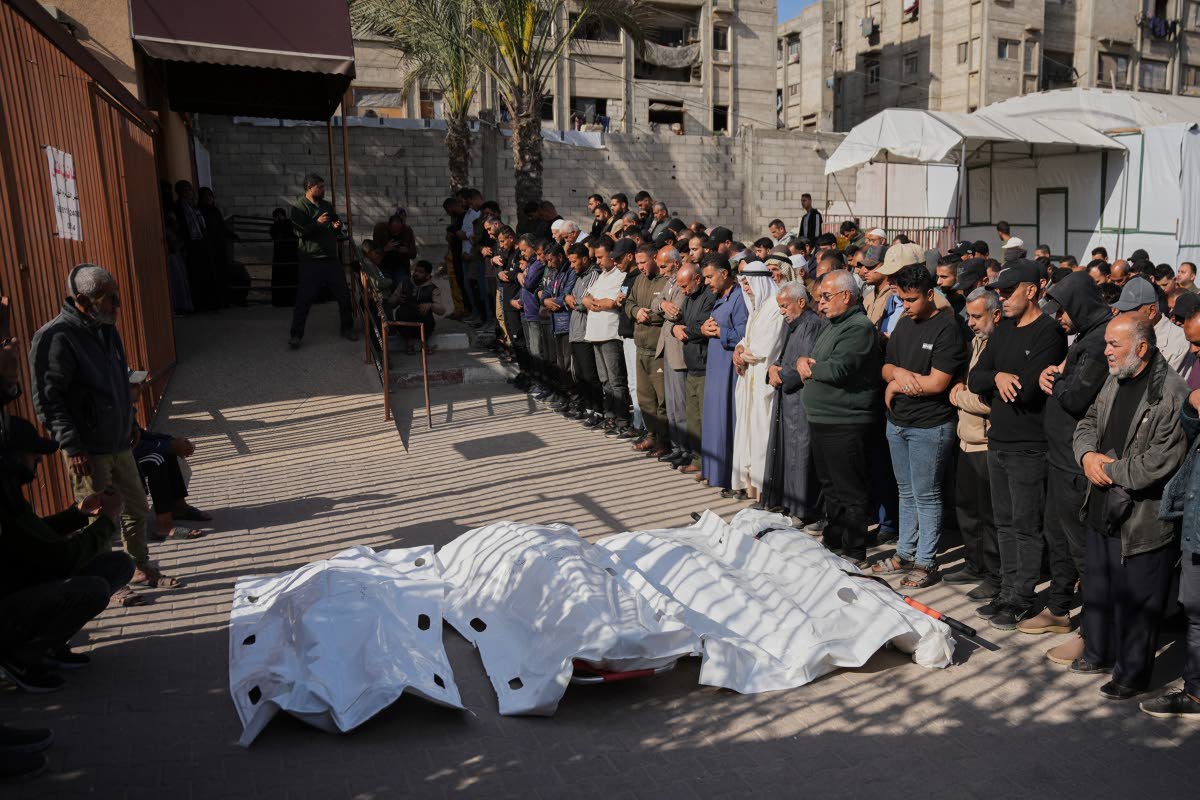 Palestinians pray beside the bodies of men killed in an Israeli strike, during their funeral at Nasser Hospital in Khan Younis, southern Gaza Strip, Tuesday, April 21, 2026.
Is it okay for Christians to go to war? Is it appropriate for a Christian to own a gun or other weapon? Is it unchristian to support a war? These questions are somewhat related to the ethical discourse that often prevails around such topics.
A current conversation in theological and political circles is that of just war theory. This is an attempt to present an acceptable and ethical basis for going to war. “Jus ad bellum” therefore advances a moral platform for going to war. Scholars, ethicists, and jurists, have for centuries studied and examined the value of the Summa Theologica’s presentation of the just war theory developed by St. Thomas Aquinas in the 13th century. He built on St. Augustine’s considerations regarding Christian morality and the matter of war.
This broad area of ethical and legal discourse calls for a just cause, a properly authorized war, and the place for it as a last resort. On a personal level, we understand that individuals may have good reasons to be armed. One recognizes that the problem is not the weapon, but the capacity and responsibility of the one carrying the weapon. It may also be argued that good people should be able to protect and defend against evil people. This may raise a whole other conversation about who determines which is good or evil. A similar thing happens with nation states. They may have difficult decisions to make about how and when to go to war. And there is the matter of using deadly force.
Some questions for us to explore may include: Does God choose sides in wars? Or is God’s will simply peace? Should lovers of peace, simply “turn the other cheek” in the face of a brutal enemy? What would you do if you had a weapon, and you knew that an enemy was trying to destroy you and your household? These questions remind us that ethical discourse around war is not always an easy one.
‘UNWILLING OR UNABLE’ DOCTRINE
If there is such a thing as the right to war, is there still a place for the UN Charter informed by Article 51 which states, “ Nothing in the present Charter shall impair the inherent right of individual or collective self-defence if an armed attack occurs against a Member of the United Nations, until the Security Council has taken measures necessary to maintain international peace and security. Measures taken by Members in the exercise of this right of self-defence shall be immediately reported to the Security Council and shall not in any way affect the authority and responsibility of the Security Council under the present Charter to take such action as it deems necessary in order to maintain or restore international peace and security.” ( UN Charter, Chapter VII). Of course, the principles of necessity and proportionality must prevail.
While Article 51 holds sway in international law, it also has political significance in the nations which subscribe to the UN Charter, mentioned herein.
How do you process the interesting concept of the “unwilling or unable” doctrine? This is where the agents of another state exercise or expand the principle of self-defence by attacking the agents of another state operating in the host territory based in another sovereign state? The United States of America, Israel, and Iran, have all invoked this doctrine. All of this has implications for how nation states accept or refuse such actions against their “guests”, albeit supposed enemies of the aggressor.
Maybe a plus for the “unwilling or unable” doctrine is that it does not trigger the collective security system. This system helps with affirming that an attack on state agents in a host country is not necessarily deemed to be an attack on the host state itself. Such conversations under the guidance of international law also help us to process the matter of just war theory.
What happens though if your own country is in breach of the principles of the just war theory? What happens if your country and religious views conflict with international law? I am suggesting that this is where kingdom values serve the Christian mandate to be agents of light, love, and peace.
PURSUANCE OF PEACE
In a time of great distress, David, celebrating the goodness of God, noted in Psalm 34:14, “Turn from evil and do good; seek peace and pursue it.” Peace is celebrated as something to be sought and pursued. In our personal and corporate and international lives, we may consider seeking and pursuing peace with every possible effort in the interest of a more wholesome human experience.
Jesus’ sermon on the mount resonates with the pursuance of peace. In Matthew 5:9, Jesus says, “Blessed are the peacemakers, for they will be called children of God.” If you are a peacemaker in your home, at work, at school, at play, in the wider community and so on, then you are one who lives and works for peace. A peacemaker is not necessarily a passive and silent agent. A peacemaker actively pursues and facilitates healing, restoration, and reconciliation in relationships. A peacemaker acts in the interest of conflict resolution.
A peacemaker is an agent of shalom. One who seeks the best interests of all parties. The wellbeing of our best humanity is nurtured. Those who differ from us are respected and protected simply for being fellow human beings. The peacemaker turns the other cheek by being patient, understanding, forgiving, engaging, for the sake of building relationships, always on a foundation of justice for all.
In any conflict, the peacemakers are interested in exploring forgiveness and seeking reconciliation for the greater good of all. This applies to conflict in a school context, a home context, the workplace or even the Strait of Hormuz. Let us pray and work for peace beginning in our homes.
Fr Sean Major-Campbell is an Anglican priest and advocate for human rights and dignity. Please send feedback to columns@gleanerjm.com and seanmajorcampbell@yahoo.com.