Elizabeth Morgan | CARICOM Reparation claims – a 10-point plan evoking sadness
Loading article...
-
-
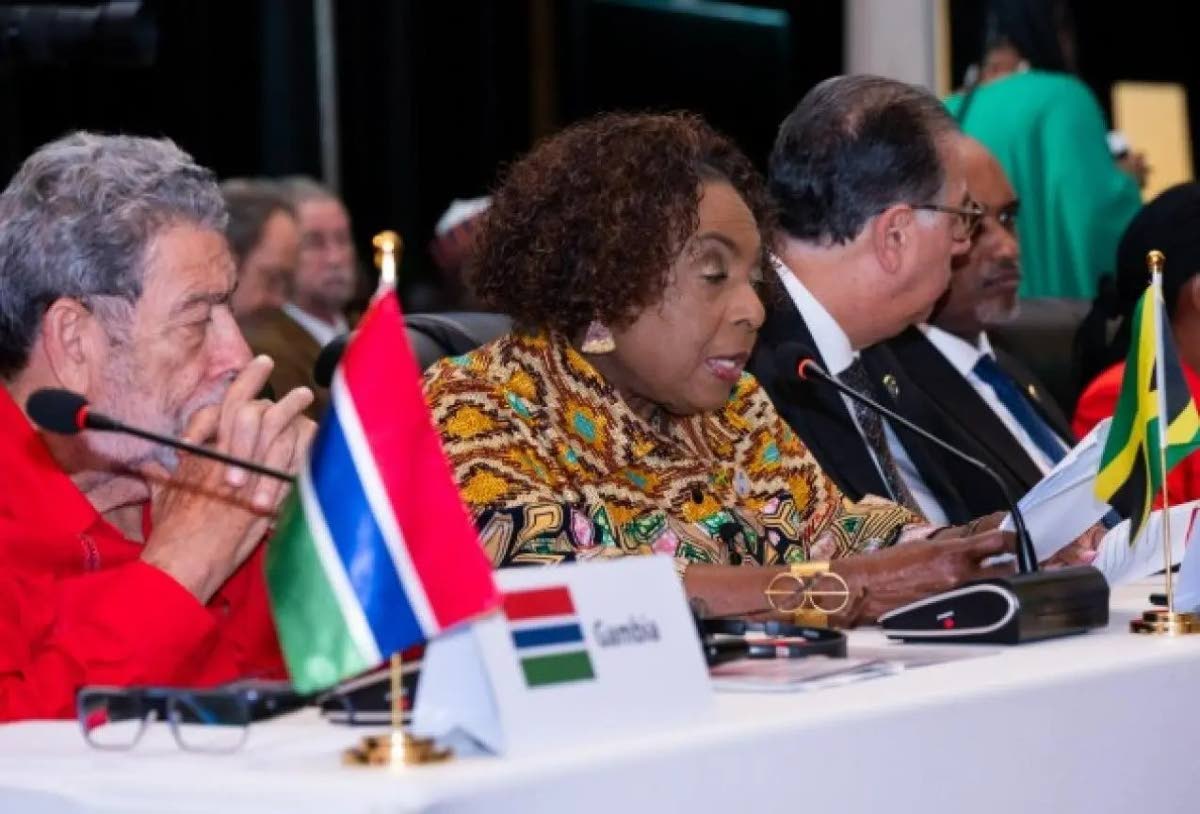 Minister of Culture, Gender, Entertainment and Sport, Olivia Grange, delivering remarks during the recent Reparations Conference in Ghana.
The intent was to review the communiqué of the 51st CARICOM Heads of Government Conference held in St Lucia, July 5-8, and reflect on its outcomes. The paragraph on reparations, however, led to a review of the revised ‘Ten-Point Plan for Reparations: a Manifesto for the Coming Enlightenment’. This document was approved by CARICOM heads, who agreed to several initiatives to advance the region’s reparations agenda, including strong visibility at the Commonwealth Heads of Government Meeting to be held in Antigua and Barbuda, November 1-4. Reading this Ten-Point Plan did not leave a sense of enlightenment, but a sense of sadness about the direction of the CARICOM region and its development.
Independence and development responsibility
Jamaica’s independence in 1962 was a time of pride and optimism about the future. As an independent country, Jamaicans were going to build on the infrastructure that was handed over to them and, paddling our own canoe, would build on this moving further towards their development goals. Jamaica had self-government from 1944. In 1962, only two additional ministries were created, the Ministry of External Affairs, taking over the country’s foreign policy, and defence, taking over the military, the Jamaica Defence Force. Other institutions and industries were in place, including a parliament, courts, police force, prisons, schools/colleges, water, including reservoirs, electricity, public transportation (bus and railway) and ports, not perfect, but workable with the expectation of improvements championed by the elected governments.
Reflecting on independence led to reviewing two pieces in this column from 2022 when Jamaica marked 60 years of independence from British rule. These articles are: ‘Jamaica’s Achievements after 60 years of Independence: a mirage’ published on August 10, 2022, and ‘A stark reality: In development, Jamaica not so far from 1962’, published on September 7, 2022. Both assessed Jamaica’s achievements in 60 years of independence and concluded that the country had not done as well as was expected in 1962.
The view was that the post-independence generations had failed to deliver the anticipated economic growth and development for many reasons, internal and external, e.g. the 1970s oil crises. It was felt that our leadership had some responsibility in our economic and social failings. Also, refer to the article of this column on ‘Reparations, development aid, and the Lomé Conventions’ of September 6, 2023.
This CARICOM Ten-Point reparations manifesto is basically indicating that Jamaicans and their post-independence leadership had no responsibility as the country’s failings in independence are mainly because of colonisation and slavery. It actually also implies that the Africans had no responsibility in slavery either. We are all hapless victims of colonisation and slavery.
Reparations, the new development strategy
It now seems that Jamaica’s new development strategy is linked to claims for reparations for colonisation and slavery, which have held back our development since independence. The impression is that CARICOM countries came to independence with nothing, no social and economic infrastructure and no development plan and, in 64 years of independence, achieved nothing in development, as we were continuously hindered by the ball and chain of the legacies of colonisation and slavery. Apparently, Jamaica’s Central Planning Unit’s 5-year development plan (1963-1968) was just an academic exercise, as were all others following
Our route to development will now come only when reparations claimed from former colonisers, in Jamaica’s case, mainly the United Kingdom (Britain), are received, binding and enforceable. Where will we stand on the path to development if these claims are not accepted and implemented? Who will actually secure these demands and their enforcement?
Some of the demands of the Ten-Point Plan:
1. Indigenous peoples – there must be specific programmes put in place aimed at supporting these communities, rectifying historical injustices and ensuring that they can thrive;
2. Repatriation and Resettlement – descendants of enslaved African peoples have a moral, ethical and legal right to return to Africa. It seems to be overlooked that African countries are sovereign states and Britain cannot determine that they take people from the Caribbean;
3. Restitution of Cultural Heritage and Cultural Reconnection – the British government is to strengthen and provide cultural institutions, such as museums, monuments, and promote cultural reconnection between Jamaica and Africa, including ensuring that information is provided about Africa;
4. Remedying the public health crisis – For CARICOM, this is manifested in the high prevalence of non-communicable diseases, inadequate healthcare infrastructure, and the health impacts of climate change. CARICOM asserts that the crisis has its roots in the colonial experience of the mass enslavement of African people, and thus it must be addressed by Britain.
5. Compensation for gender-based violence and assault on family – CARICOM is demanding from the British government a positive reparatory justice response to the destruction of the right to family lineage and the emotional harm that still affects black communities;
6. Psychological rehabilitation – Britain must repair the psychological trauma caused by the legacies of their crimes against humanity, which have left deep mental and social scars. They must support, through reparations, funding for all initiatives that will promote cultural reclamation and provide a sense of closure and psychological healing to affected populations and communities;
7. The right to sovereignty and development: technology, innovation and entrepreneurship - CARICOM demands the right to complete sovereignty and development, with a special focus on technology, innovation, and entrepreneurship. So, Britain must ensure Jamaica’s right to sovereignty and development, including transfer of technology, etc. Note, this involves the global private sector; and
8. Debt cancellation, monetary compensation and decolonisation – CARICOM is demanding monetary compensation, in various forms, from all involved in the trans-Atlantic slave trade, including monarchies, governments, institutions, individuals and others. This must include debt relief. It is noted that most of Jamaica’s external debt, acquired as an independent, sovereign nation, is owed to multilateral institutions and to China. How is this debt relief to be accomplished?
Note that these demands must be binding and enforceable. This Ten- Point Plan, it seems, was drafted by a committee of academics and advocates. It was not easy to read and comprehend. It does not seem practical. It raises many questions about the demands and how they could be realistically secured and implemented.
How this unfolds in the coming months leading to the Commonwealth Heads of Government Meeting will be interesting to see. Others not involved in the Reparations Committees need to review this manifesto and provide independent and thoughtful analyses.
Elizabeth Morgan is a specialist in international trade policy and international politics. Send feedback to columns@gleanerjm.com